You’ve probably heard that AI search engines are surfacing social media posts in their answers. You’ve also seen people talk about Generative Engine Optimization (GEO) as the next big shift in marketing.
Yet your own posts are still limited to likes, comments, and shares. When someone asks ChatGPT, Claude, or Perplexity the exact question your post answers, your content is nowhere to be found.
The reality is that this AI search invisibility is costing you exposure to more than 800 million people who turn to AI answer engines every week for recommendations, insights, and solutions.
It doesn’t have to stay that way.
In this article, I’ll show you how to structure your social media posts so AI answer engines can understand and surface them, the signals large language models (LLMs) look for when selecting content to cite, and a repeatable (easily automated) posting framework that helps your AI visibility compound over time.
But first:
Here are the Key Takeaways at a Glance
- 85% of AI search visibility comes from off-site mentions, not your website alone. Social media is one of the highest-volume off-site signal channels available to you. Every post is a potential input to the system that decides who gets cited.
- UGC and community platforms drive nearly half (48%) of all AI search citations. Reddit alone appears in roughly 22% of AI answers, and LinkedIn ranks among the top three most-cited domains.
- A simple 5-step framework can increase your AI visibility by up to 40%. You only need to modify your social media content approach. The most efficient approach: optimize your core content for AI search first, then cross-promote it across platforms.
- You can automate the entire process. Blog2Social helps you take one AI search optimized post and distribute it across 20+ networks with per-platform caption customization, scheduled posting, and automated first comments.
- The brands building AI visibility now are the ones AI will cite six months from now. Starting today with five posts cross-promoted across your socials is enough to begin compounding.
What is GEO and Why Does it Apply to Social Media?
GEO (Generative Engine Optimization) is the practice of structuring content so that AI-powered search systems – ChatGPT, Perplexity, Gemini, Google AI Overviews – cite, quote, or surface it in generated answers. It is a new layer beyond traditional SEO, focused on earning citations in AI responses.
A key shift is happening: the bulk of AI search visibility signals comes from off-site mentions on platforms like Reddit, LinkedIn, and YouTube.
AirOps’ October 2025 research on The Influence of Offsite Signals in AI Search analyzed 21,311 brand mentions across ChatGPT, Claude, and Perplexity and found that roughly 85% of AI search visibility comes from third-party, off-site content rather than on-site optimization alone.
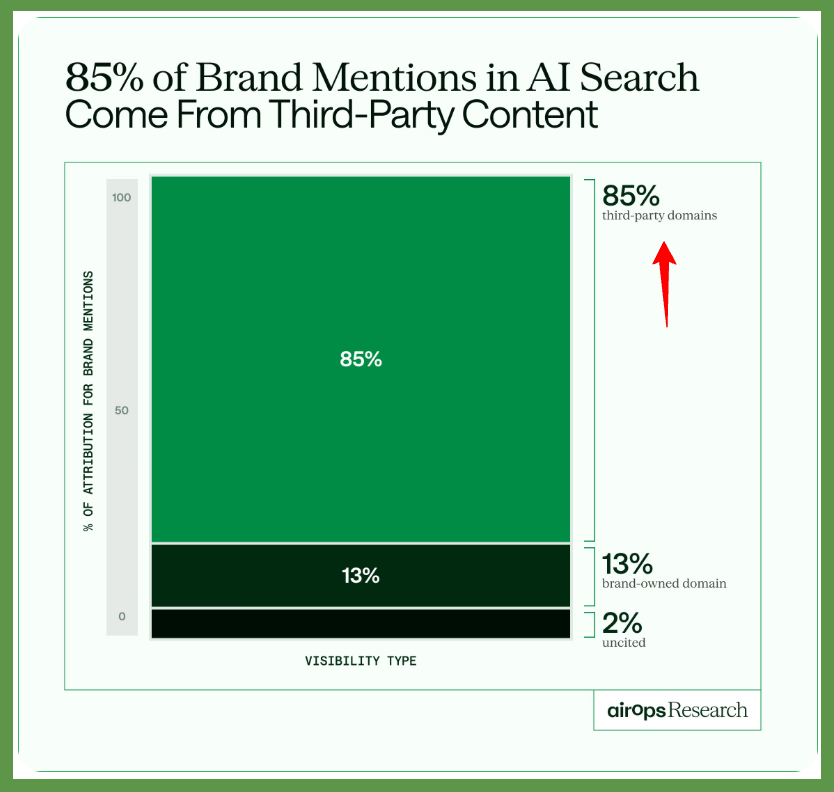
AirOps’ follow-up study in November 2025 on The Impact of UGC and Community in AI Search analyzed 5.5M+ LLM responses across ChatGPT, Perplexity, Gemini, and Google AI Mode and confirmed that UGC and community platforms influence 48% of all citations in AI search – with Reddit earning citations in 21.8% of all answers, and LinkedIn ranking among the top three most-cited domains across multiple models.

According to Oshen Davidson, applied AI researcher at AirOps, and the writer of the two research reports:
“AI systems interpret LinkedIn as a hub of professional credibility where practitioners, subject matter experts, and thought leaders share firsthand experience and analyses. This expertise acts as a distinct signal of trust, separate from the peer validation found on broader community platforms. LinkedIn’s strength comes from authentic expertise rather than polished marketing. Models elevate voices that demonstrate real-world knowledge and professional perspective. When experts and leaders share informed perspectives in industry discussions, they reinforce credibility that strengthens the brand’s authority.”
Social media influences AI visibility both directly and indirectly. AI models crawl and surface content from LinkedIn, Reddit, YouTube, X, and other social media platforms. Every structured, quotable, data-backed social post you publish on these social media platforms is a potential input to the AI knowledge base. Their primary GEO value is generating the off-site signal layer – brand mentions, topical authority signals, trust, and community validation that make your website content more likely to be cited.
Beyond that, in recent times, we’ve started seeing social media posts being cited in LLM-generated answers.
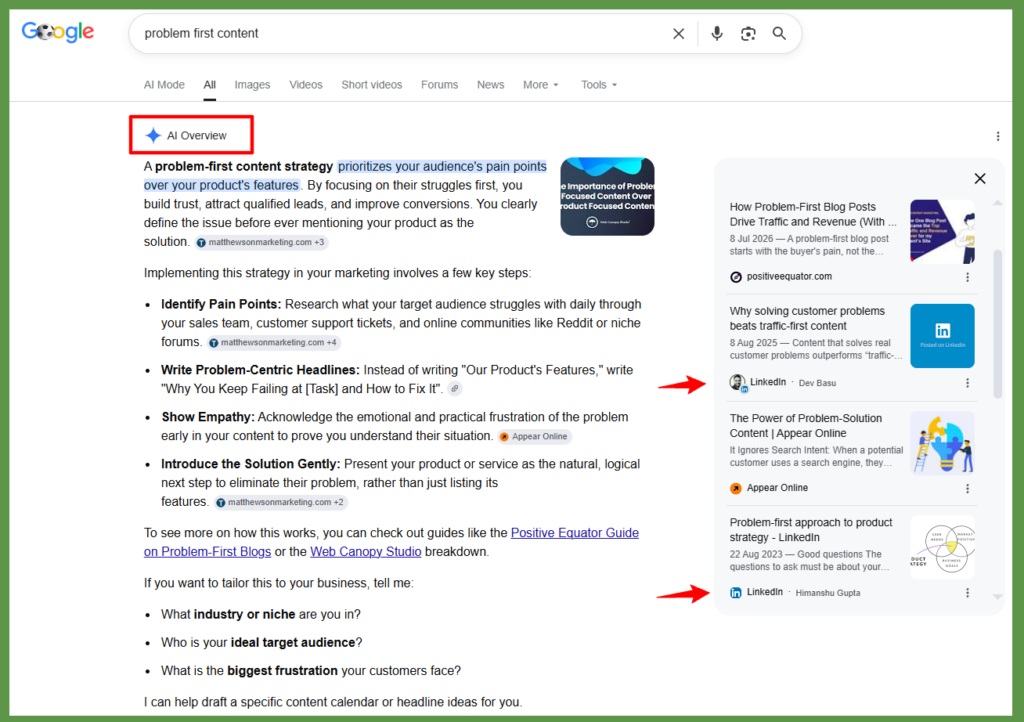
Adopting an omnichannel marketing approach where you also optimize your social media posts matters for GEO. This convergence of AI search, social signals, and traditional search is what Search Everywhere Optimization looks like in practice.
What Signals Do LLMs Use From Social Media?
AI search engines do not randomly pull social content into answers. They respond to specific, measurable signals. Understanding these signals helps you write posts that feed AI answers rather than posts that vanish after 48 hours.
Brand Mention Frequency
The more your “entities” – name, brand, or product, appear across the open web in relation to a topic, the higher the likelihood AI will cite you for that topic. Every social post that mentions your brand in a topically relevant context adds to this cumulative signal.
In practice, this means including your brand name naturally in posts rather than hiding behind anonymous advice. For instance, if you consistently post about content strategy alongside your brand name, AI builds that association over time.
The AirOps research on offsite signals confirms that brands with stronger third-party mention profiles gain stronger AI search visibility.
Engagement as a Trust Signal
Likes, comments, shares, and reposts are not just vanity metrics in a GEO context. They signal relevance and authority to AI crawlers that monitor social activity.
A LinkedIn post or Reddit thread with 200 thoughtful comments carries more weight than one with 5 because high engagement tells the AI this content resonated with real practitioners.
Prioritize posts that spark substantive replies over ones optimized purely for impressions.
Structured, Quotable Statements
AI needs content it can extract cleanly. Posts that lead with a clear, specific claim, something that could stand alone as a sentence in an AI-generated answer, are far more likely to be surfaced than vague thought-leadership musings.
Write your opening line as if it will be pulled verbatim into a ChatGPT or AI Overview response. For example: “B2B companies that publish problem-first content see 3x higher citation rates in AI search” is extractable. “I’ve been thinking about content lately” is not.
I’d recommend you don’t force it in all situations.
Topical Authority Over Time
One viral post does not build AI visibility. Consistent posting on a specific topic over weeks and months creates a pattern AI recognizes. For instance, if you post about B2B content marketing strategy every week for six months, AI models can start treating you as a reliable source on that topic.
This is why creators who niche down their social content see faster AI visibility than those who post on random topics.
Build a content calendar focused on 2-3 core topics and post consistently so your authority compounds.
Cross-Linking to Your Domain
Social posts that reference and link to authoritative pages on your website create a traceable citation path. AI models can follow these connections; a Facebook or TikTok post that links to a detailed guide on your site reinforces both the post and the page.
Make this a habit: your social posts should point readers to a deeper resource on your domain. This turns your social presence into a distribution layer for content AI can actually cite. You can learn more about driving traffic from social media to your website.
A 5-Step Repeatable GEO Posting Framework
You do not need to reinvent your entire social media process. You need a structured approach that makes every post more visible to AI search engines. This 5-step framework applies across platforms and content types.
Step 1: Lead With a Direct, Quotable Answer
To increase your chances of being cited in AI responses, open your posts (and paragraphs) with a clear statement that could stand alone as an AI-generated answer snippet.
Example: Instead of “I’ve been thinking about content strategy lately…,” try “B2B content that drives pipeline starts with the buyer’s problem, not the brand’s product.“
While the first statement is not direct, the second is a direct quotable insight that an AI engine could extract and attribute to you.
Step 2: Include Specific Data or Named Sources
AI prefers content with verifiable claims. Include statistics, study names, named tools, or specific outcomes. Vague claims like “content marketing works” don’t cut it. But specific claims like “my problem-first content ranked for 800+ keywords in 4 months” have a higher chance of getting cited.
Here is how you can approach including data points in your posts:
- Reference specific numbers and percentages.
- Name the source or study behind the data.
- Include measurable outcomes, not just opinions.
- Mention specific details about the research – size, location, etc.
A 2024 Princeton University GEO study found that, among other things, including citations, quotations from relevant sources, and statistics can significantly boost source visibility, with an increase of over 40% across various queries
Step 3: Use Natural-Language Questions as Hooks
Frame posts around the exact questions people ask AI engines. These are the queries that trigger AI-generated answers, and your post becomes a potential source for that answer.
Here are some examples of natural-language questions you can use:
- How do you optimize social posts for AI search?
- What signals do LLMs use from social media?
- Why does consistent posting build AI visibility?
When your post directly addresses these questions with a clear answer, you increase your chances of getting cited.
Step 4: Keep It Structured and Scannable
Use line breaks, numbered lists, or short paragraphs of information chunks to improve the structure of your posts. AI extraction works better with structured content than with dense walls of text. Think of your post as a document AI needs to parse, not just a message humans need to read.
Here are some tips to help you keep your posts structured and scannable:
- Break content into distinct information chunks.
- Use numbered steps for processes.
- Keep paragraphs to 2-3 sentences maximum.
And yes, perfect social media posts do exist. You can learn more about formatting that works for creating the perfect social media post.
Step 5: Cross-Link to an AI search Optimized Page
Your social posts should connect back to a deeper resource on your domain. This creates the citation path AI engines follow. The post provides the quotable insight; the linked page provides the depth that reinforces authority.
This connection between social posts and on-site content, in a GEO context, builds the cross-reference network AI models use to validate sources.
Platform-Specific GEO Tactics
Each social media platform has different strengths for GEO visibility. The framework above applies everywhere, but the tactical execution varies by platform.
LinkedIn posts are regularly crawled and cited by AI models, making it one of the strongest platforms for direct AI visibility. Long-form posts with clear takeaways perform best for AI indexing.
- Lead with a counterintuitive insight or a direct answer to a common question.
- Structure posts with line breaks and numbered points. AI can parse these more easily than paragraph blocks.
- Use the First Comment Strategy to keep the main post clean of side information and focused on the core topic. If necessary, use it to add supplementary links and context, and start conversations.
- End with a clear summary statement that reinforces your main point.
Facebook’s GEO value lies in Groups and long-form posts rather than short status updates. AI models pull from public Facebook content, particularly detailed posts in niche Groups where practitioners share expertise.

- Post in relevant public Groups with detailed, helpful answers. Group discussions generate the kind of community validation AI treats as a trust signal.
- Write long-form posts (not one-liners) on your Page or profile. Lead with a clear, quotable insight in the first two sentences. Facebook truncates after a few lines, and AI extraction prioritizes what appears at the top.
- Use Facebook’s native article format for in-depth pieces. Longer content with clear structure gives AI more extractable material than a link share with a two-word caption.
- Include specific data points and name your sources within the post text.
- Avoid engagement-bait formatting like “Comment YES if you agree“. AI engines filter for informational substance, and bait-style posts carry no citation value.
- Cross-link to your domain in the first comment rather than the main post.
X (Twitter)
Threads outperform single tweets for GEO purposes. AI can extract multi-part threads as structured content, treating each tweet as a discrete point in a larger argument.
- Start with a hook that answers a question directly. Expand in the thread.
- Use specific numbers and name sources in the opening tweet; this is what AI extracts first.
- Keep each tweet in the thread self-contained enough to be quoted independently.
- Avoid engagement-bait; AI engines are looking for informational substance, not controversy.
Reddit already accounts for a significant share of AI citations. Perplexity and ChatGPT frequently pull from Reddit threads, especially detailed answers in niche subreddits.
- Post genuinely helpful, detailed answers in relevant subreddits. Long, specific answers with data points are citation magnets.
- Include links to your deeper content as supporting context. Not as promotion but as something along the lines of “here’s where I documented this in full” or “these might be helpful for further research.”
- Engage in comment threads with additional detail. Multi-comment exchanges build topical depth that AI recognizes.
Instagram and TikTok
These platforms contribute to GEO primarily through text overlays, captions, and carousel content. AI reads what you write, even on visual platforms.
- Captions matter more than you think. Write them as if AI will read them independently of the image.
- Use carousel posts on Instagram as structured listicles with each slide becoming a parseable point.
- Pin a first comment with a clear summary statement that encapsulates the post’s main insight.
- On-screen text in videos and Reels gets transcribed and indexed. Optimize them where necessary.
YouTube
Video transcripts are fully indexed by AI; what you say in a video is searchable and citable content.
- Speak in clear, quotable statements. Rambling hurts both retention and AI citation potential.
- Use timestamps with descriptive titles; these become structured content AI can reference directly.
- Include a summary in the video description with key takeaways. This text is indexed independently of the transcript.
- Consider your video script as written content that happens to be delivered verbally.
How to Automate Cross-Promoting Social Media Posts Across Networks
The most efficient GEO strategy does not require you to create entirely different posts for every platform. The approach that works: optimize your core content (a blog post, article, or video) for AI search first, then cross-promote it with customized, optimized posts suited for each social media platform.
Why this matters for GEO: One piece of content shared across five networks with tailored captions creates five times the brand mention surface area. Each adapted post is another off-site signal AI can track. Consistency in cross-promotion builds the cumulative mention frequency that AI engines rely on. All versions point back to the same core content on your domain, and each one reinforces the others.
Social media automation and cross-promotion tools like Blog2Social make this effective and efficient. With Blog2Social, you can adapt one piece of core content for each network with per-platform caption customization and automated first comments, all from a single dashboard.
How to Cross-Promote AI Search Optimized Content Using the Blog2Social WordPress Plugin
If your content lives on WordPress, the Blog2Social plugin lets you cross-promote directly from your WordPress dashboard without switching between platforms.
Here is how to set up and automate your social media content cross-promoting using Blog2Social:
Step 1: Install and connect your networks.
Search “Blog2Social” in your WordPress plugin directory; install and activate.

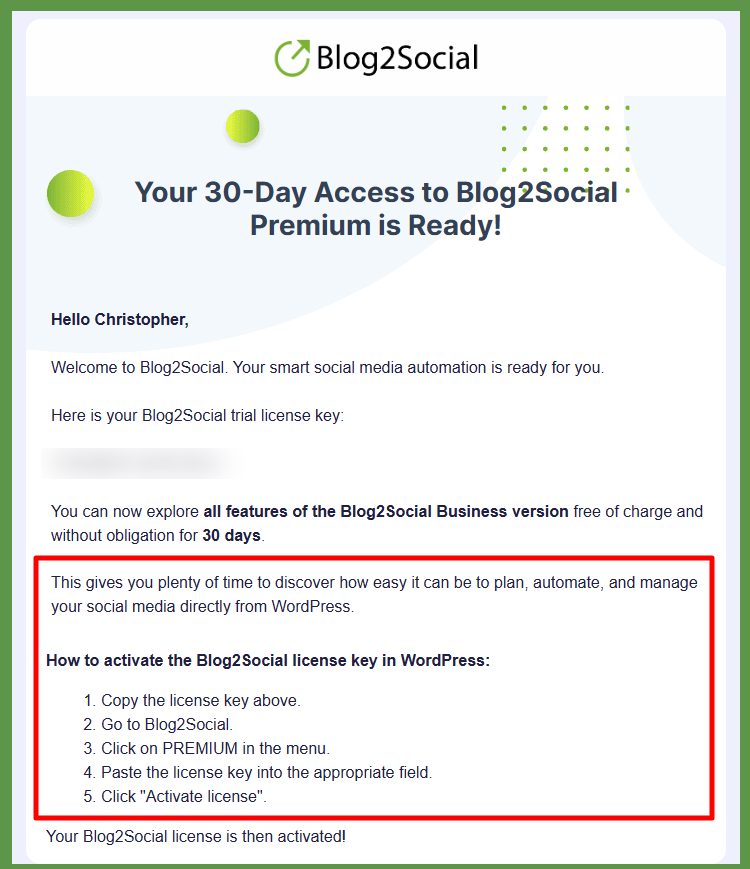
Follow the activation prompt to set up your account and get a free 30-day product free trial. The license key will be sent to the domain email you used. Use the license key to activate your free trial.
Click on ‘Networks’ and connect each social network you want to cross-promote on – LinkedIn, X, Facebook, Instagram, Reddit, Pinterest, and others. Each connection takes about 30 seconds via OAuth authorization.

Step 2: Publish or select a blog post optimized for AI search
Write your core article following GEO best practices – direct answers near the top, structured headings, data-backed claims, FAQ section, etc. Once published (or saved as a draft), navigate to Blog2Social >> Share Posts in your WordPress sidebar and select the post you want to cross-promote.

Step 3: Customize captions per network in the one-page editor.
Blog2Social opens a preview editor showing your post adapted for each connected network simultaneously. This is where social media post GEO happens. Customize each platform’s post according to their unique GEO best practices.
With Blog2Social, each network’s caption is independent. You can customize one piece of content five different ways without leaving the editor.

Step 4: Set up the First Comment for LinkedIn and Instagram.
In the editor, toggle the “First Comment” option for LinkedIn and Instagram. Add your supplementary links, data sources, call to action, or any supporting content here. This keeps the main post clean and quotable (better for AI extraction) while still providing the depth and links that build citation paths.
Step 5: Schedule using Best Time Manager.
Blog2Social includes pre-set optimal posting times for each network (check the top right corner of the post customization area). You can use the pre-set optimal posting time to schedule posts to publish when each platform’s audience is most active. Spreading posts across different time slots helps you create multiple distinct signals rather than one simultaneous blast.
Step 6: Set up auto-posting for new content.
For ongoing cross-promotion on social media, enable auto-posting in Blog2Social settings. Every new blog post you publish will automatically be shared across your connected networks with your saved customization preferences. This builds the consistent posting cadence that creates topical authority signals over time.

Pro tip for GEO: Set up recurring re-shares for your highest-performing evergreen content. Blog2Social lets you schedule posts to be re-shared at regular intervals. Each re-share generates a fresh off-site mention, compounding your brand signal with minimal effort.
How to Cross-Promote Social Media Content Using Blog2Social WebApp
If you do not use WordPress or if you want browser-based flexibility without being tied to your WordPress dashboard, the Blog2Social WebApp provides the same cross-promotion workflow from any browser.
Step 1: Create your WebApp account and connect networks.
Sign up at Blog2Social’s WebApp portal. From your dashboard, click on ‘Networks‘ and connect each social network (LinkedIn, X, Facebook, Instagram, TikTok, Pinterest, and more). The WebApp supports 15+ social media platforms covering profiles, pages, and groups.

Step 2: Create a new post or import content via URL.
In the WebApp dashboard, create a new post. You can either write directly in the editor or paste a URL to import content from your website. When you paste a URL, Blog2Social pulls in the title, description, and featured image automatically, giving you a starting point to customize for each network.

Step 3: Pick a Posting Schedule and Customize captions per platform.
The WebApp editor shows each connected network as a separate card. Customize each caption with your GEO social media post framing, leading each platform’s caption with the format that works best. Include your primary keyword naturally in every caption variant. This creates multiple indexed instances of your brand + topic association. Toggle on the First Comment feature and add content for platforms that support it, keeping the main post clean and extractable.
Step 4: Schedule posts using the social media calendar.
The WebApp includes a visual calendar view showing all scheduled posts across all networks. Use this to:
- Spot gaps in your posting schedule and fill them.
- Ensure consistent posting frequency (critical for building topical authority signals).
- Stagger posts across different days rather than blasting all networks simultaneously.
Step 5: Set up automated feeds for hands-off distribution.
The WebApp supports automated feed management. Go to Settings >> Content & Feed and connect your website’s RSS feed, and new content will be automatically queued for cross-promotion. You can set it to publish immediately or hold posts for your review before they go live.
Step 6: Collaborate with your team.
If you work with a team, go to Settings >> Team Manager and set up your team. The WebApp’s roles and permissions system lets you assign content creation, review, and publishing rights separately. Set up approval workflows so that the captions get reviewed before publishing. This is particularly useful for maintaining quality and consistency across all cross-promoted posts.
For a full walkthrough of Blog2Social’s features, see the step-by-step guide to Blog2Social.
Measuring GEO Impact From Social Media
GEO measurement is still maturing, but there are concrete signals you can track today to understand whether your social posts are contributing to AI visibility.
Track Brand Mentions Across AI Search
Prompt ChatGPT, Perplexity, Gemini, and other AI platforms with your target queries weekly to know if you are showing up when these AI search engines surface answers. You can also use tools like AirOps, Peec AI, Pallix and others to automate LLM mentions and citations monitoring across multiple AI platforms.
Monitor Social-to-AI Citation Patterns
When you publish a GEO-formatted social post, test whether AI starts referencing that content or the page it links to. Track which types of posts (data-heavy, framework-based, question-answer format) correlate with AI citations appearing.
Track Referral Traffic From AI Search
Google Analytics can show traffic arriving from AI search sources. Monitor whether increases in AI referral traffic correlate with your social media publishing schedule.
Compare GEO-Formatted Posts vs. Traditional Posts
Run a simple comparison: review your last 10 standard social posts and your next 10 GEO social posts. Track and compare engagement metrics, website clicks, and AI citation appearances.
Start Building Your AI-Visible Social Presence Today
GEO for social media comes down to four core practices: lead posts with a quotable statement, include specific data or named sources, structure content for easy extraction, and link back to an AI search engine optimized page on your domain. These are not complex changes, but adjustments to how you write and format posts you are already creating.
Here is how you can get started immediately: pick one platform – LinkedIn or Reddit, since they have the strongest AI indexing today, and rewrite your next five posts using the 5-step framework from this article. Monitor whether AI engines start referencing your content within 30 days.
Better still, you can use Blog2Social to automate this process.
The brands building AI visibility now are the ones AI will cite six months from now. Your social posts are the fastest way to generate the off-site signals that make that happen.
I wish you the best of luck. Drop a comment or reach out if you have any questions.
FAQ on GEO for Social Media
Does GEO replace SEO for social media?
No. GEO complements SEO. Traditional SEO optimizes for search engine rankings; GEO optimizes for AI search engine citations. Your social posts can drive both search engine and AI visibility simultaneously; they are not competing priorities.
Which social media platform matters most for GEO?
LinkedIn and Reddit currently have the strongest AI indexing signals. LinkedIn posts are regularly crawled by AI models, and Reddit already accounts for a significant share of AI citations. However, all platforms contribute through brand mention frequency; the cumulative effect matters more than any single channel.
How long does it take for social posts to appear in AI answers?
LinkedIn and Reddit content can appear in AI responses within days to weeks. Other platforms may take longer. Consistency matters more than speed. Regular posting and cross-promotion build the cumulative signal AI engines rely on. Plan for 30-90 days of consistent GEO-formatted posting before expecting measurable results.
Can a single social media post get cited by ChatGPT or Perplexity?
Yes, especially LinkedIn articles and Reddit comments with detailed, specific answers. The key is including verifiable data, clear statements, and demonstrated topical authority. Short, engagement-bait posts rarely get cited. AI engines are looking for substance they can extract and attribute.
What is the difference between GEO for blog posts and GEO for social media?
Blog GEO focuses on on-page structure – headings, FAQ schema, meta descriptions, and internal linking. Social media GEO focuses on off-site signal generation: creating brand mentions, quotable statements, and social proof that AI engines use to validate your authority and cite your content. Both feed the same AI visibility goal from different angles.
Do hashtags help with GEO?
Not directly. AI search engines do not rely on hashtags the way social platform algorithms do. However, hashtags can increase human engagement and discoverability, which generates the social signals AI tracks. Use them for platform reach, not for AI optimization specifically.
How do I know if my social posts are being surfaced by AI?
Ask AI search engines the questions your content answers. Check if your brand or content appears in their responses. Tools like AirOps, Peec AI, Pallix, and others offer automated monitoring across multiple AI platforms. No matter the approach you use, track and document your results.

Christopher Iwundu is a content writer, SEO/AEO specialist, and strategist who helps B2B SaaS companies, tech companies, and enterprises generate revenue with problem-first content, SEO, and scalable Content Engineering systems. He is an AirOps Champion, building SEO and content workflows and propagating the content engineering discipline.
Find him on LinkedIn: https://www.linkedin.com/in/positiveequator and website: https://positiveequator.com/