
A well-structured blog post is easier to read, easier to understand, and far more likely to perform well in search results. But in today’s content landscape, writing a “perfect blog post” means more than simply adding keywords and paragraphs. Your content must be structured so that readers, search engines, and AI-powered search assistants can all understand and extract value from it. In this guide, we’ll show you how to structure your content using the anatomy of a perfect blog post, updated for SEO, AEO, and AI-powered search.
What Makes a Blog Post Perform Better Today?
A high-performing blog post needs more than a good idea. It should have a clear headline, a strong introduction, structured headings, helpful visuals, internal and external links, and a clear call to action.
To increase visibility in both traditional search and AI-powered search, your content should also:
Core AEO / GEO elements
- answer real reader questions directly
- use clear sections and structured headings
- include concise summaries or key takeaways
- provide logical information hierarchy
- offer useful examples and actionable advice
Why this structure matters
Content that is well-structured, easy to summarize, and genuinely helpful is more likely to appear in:
Why structure matters more than ever
With attention spans shrinking and the amount of content online increasing every day, readers rarely consume blog posts word by word from start to finish. Most scan first and only continue reading when the article looks useful and easy to follow.
Dense, unstructured text blocks make that decision much harder in your favor.
The Attention Trap
Research and long-standing content experience show that readers often decide within seconds whether a post is worth their attention:
- The average attention span online is less than 8 seconds
- 43% of readers skim blog posts before deciding whether to read them
- The average time spent reading an article is about 37 seconds
If your article appears as a wall of text without structure, headings, or visual guidance, many readers will simply move on.
The solution is simple: structure your content clearly and strategically.
A well-organized blog post improves:
- readability for human readers
- discoverability in traditional search engines
- extractability for AI search assistants and answer engines
This is why modern blog writing is no longer just about “good text.” It is about information design.
What are SEO, AEO, and GEO, and what do they matter for blog posts?
In a “search everywhere” environment, people no longer look for information only through traditional search engines like Google. They also discover answers through AI assistants, generative search tools, voice search, social platforms, and knowledge engines.
That means a “perfect blog post” today needs more than readability and keywords. Your content should also be structured so that search engines, AI assistants, and generative answer engines can quickly identify, extract, summarize, and recommend the most useful parts:
- SEO (Search Engine Optimization) focuses on optimizing content so it ranks well in classic search results.
- AEO (Answer Engine Optimization) goes a step further by structuring content so answer engines and voice assistants can extract clear, direct answers to user questions.
- GEO (Generative Engine Optimization) prepares content so generative AI systems can understand, summarize, and reference it when creating AI-generated responses.
Together, SEO, AEO, and GEO help ensure your content is visible and usable across the entire modern search ecosystem.
If your article is well organized, clearly written, and rich in directly usable answers, it becomes more useful for readers and more visible in AI-driven search experience. This structure supports readers, SEO, AEO, and GEO at the same time.
10 tips for the perfect anatomy of a modern blog post
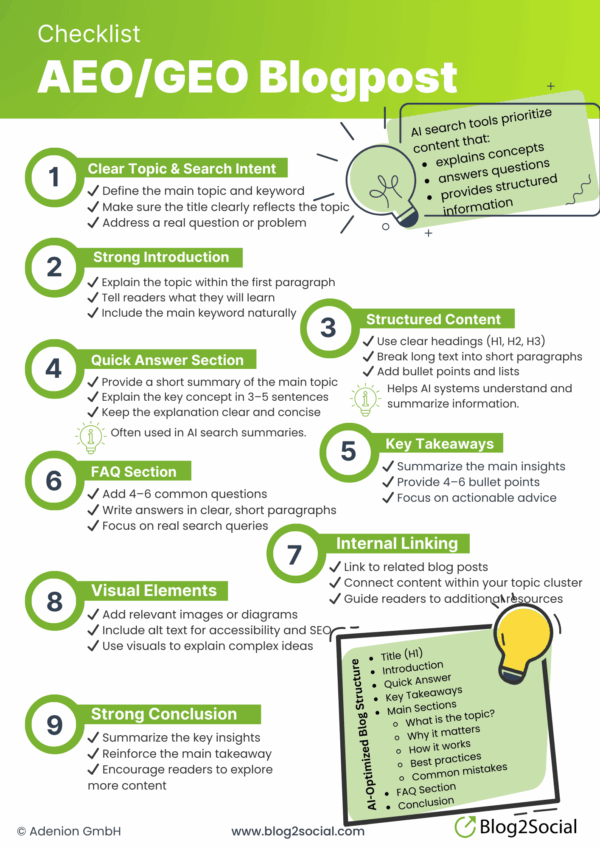
The structure of a high-performing blog post now typically includes the following building blocks:
- A clear and compelling headline
- A direct introduction with a reader benefit
- A quick answer section near the beginning
- Structured main sections with descriptive headings
- Useful examples, visuals, and practical guidance
- Keywords and links for contextual sources
- Key takeaways or summary bullets
- A FAQ section with real search-style questions
- A conclusion with a clear next step
- Promotion and distribution across multiple channels
1. Write a headline that is clear, relevant, and worth clicking
Every great blog post starts with a headline that grabs attention.
Your title is the first thing readers see in search results, on social media, and in newsletters. A strong headline helps people understand what the article is about and why it is worth reading.
Studies show that eight out of ten people read the headline, but only two continue reading the full article.
A good headline should:
- clearly reflect the topic
- contain your primary keyword
- spark curiosity or highlight value
- promise a clear benefit
Example formats that perform well include:
- How-to headlines
- List-based titles
- Problem-solving titles
- Guides or frameworks
A strong title also improves visibility in search results and helps AI-powered search systems understand the topic of your content.
As William Faulkner once said:
“You have got to write the first sentence of a story so that whoever reads it will want to read the second one.”
2. Use an introduction that explains the topic immediately
The introduction should not delay the point.
It should explain:
- what the article covers
- why it matters
- what the reader will get from it
This is especially important for AEO and GEO because the opening paragraphs are often used by answer engines and AI tools to identify the core purpose of the page.
A strong introduction does not need to be long. It needs to be clear.
3. Add a Quick Answer section near the top
This is one of the most important AEO/GEO improvements.
A Quick Answer section gives readers an immediate summary and gives AI systems a concise block of extractable information.
It works best when it:
- directly answers the main question
- uses 2–4 clear sentences
- appears early in the article
- avoids filler language
For many topics, this section can become the most reusable part of the article in AI search and featured answer environments.
4. Break the main content into short, structured sections
One of the biggest mistakes bloggers make is presenting information in long, dense text blocks.
Breaking your article into smaller, well-organized sections dramatically improves readability.
Follow these structural principles:
Use Clear Headings
Headings guide readers through your content and help search engines understand the structure of your article.
Use a logical hierarchy:
- H1 – main title
- H2 – main sections
- H3 – subtopics
Keep Paragraphs Short
Short paragraphs are easier to read on both desktop and mobile devices.
Aim for:
- paragraphs under 150 words
- sections under 300 words
Use Lists and Formatting
Lists make information easier to scan and highlight key ideas quickly.
Use:
- bullet lists
- numbered steps
- bold text for important terms
- occasional italics for emphasis
Write in Clear Language
Avoid unnecessary jargon and keep sentences simple. The clearer your writing is, the easier it is for readers and AI tools to understand.
5. Use visuals to reinforce understanding
Images, diagrams, screenshots, charts, and infographics can clarify ideas faster than text alone.

Visual content helps:
- explain abstract concepts
- improve retention
- increase shareability
- support engagement on social platforms
For SEO and AI visibility, visuals should also include descriptive filenames and alt text.
6. Add keywords naturally and strengthen context with links
Keywords still matter, but they must be used naturally.
Keywords help search engines understand what your content is about.
To optimize your blog post for SEO and AI search:
- include your main keyword in the title
- add it naturally in the introduction
- use it in subheadings where appropriate
- include it in image alt text
However, modern search engines prioritize context and usefulness, not keyword repetition.
Equally important are links.
Internal Links
Linking to related articles helps:
- guide readers through your site
- strengthen topical authority
- improve SEO
External Links
Linking to credible sources:
- improves trust signals for search engines
- adds credibility to your content
- helps readers explore topics further
7. Include Key Takeaways for faster scanning and extraction
Key takeaways are one of the easiest ways to improve both readability and AI extractability.
A strong takeaway section:
- summarizes the main insights
- makes the article easier to skim
- provides reusable answer fragments
- supports summary generation
Use 4–6 bullets where possible and focus on practical insights rather than generic restatements.
8. Add an FAQ section with real questions
FAQ sections are no longer optional extras for many blog posts. They are one of the strongest bridges between classic blogging and AI-search visibility.
A strong FAQ section should:
- answer real follow-up questions
- include natural-language queries
- add value beyond the main text
- cover long-tail search intent
Examples:
- How long should a blog post be?
- What is the difference between SEO and AEO?
- Why do key takeaways help AI search?
- How often should old blog posts be updated?
Question-and-answer structures are especially easy for AI tools to extract.
9. End with a conclusion and a clear next step
A strong blog post should end with orientation, not just a stopping point.
Your conclusion should:
- reinforce the main lesson
- summarize the value of the article
- invite the reader to continue
Then add a CTA such as:
- read a related guide
- download a checklist
- comment with a question
- subscribe for updates
10. Promote the article beyond the blog
Even the best blog post will not reach its full potential without promotion.
Social media distribution helps your content gain:
- traffic
- engagement
- backlinks
- brand visibility
Consider sharing your content across multiple platforms such as:
- Twitter / X
- Google Business
You can also share your content in:
- relevant groups and communities
- newsletters
- forums and discussion platforms
- content syndication platforms like Medium
Consistency matters. Instead of sharing your article only once, create a cross-promotion strategy that shares the content multiple times using different visuals and captions.
Social media automation tools can help schedule and distribute posts efficiently a
Content that is reshared with different captions, visuals, and angles often performs much better over time than content shared only once.
Tip: Set up a social media cross-promotion plan to schedule and share your blog posts on social media.
Conclusion
The perfect blog post today is not just well-written. It is well-structured for both people and machines.
If you want your content to perform better in 2026 and beyond, you need more than a headline, some paragraphs, and a few keywords. You need a format that supports readability, search visibility, direct answers, summarization, and multi-channel distribution.
That means building every article with:
- clarity
- structure
- extractable answers
- useful summaries
- and real reader value
That is what turns a standard blog post into a modern SEO, AEO, and GEO-ready content asset.
Free guide including checklist for bloggers.


Melanie Tamblé is co-founder and co-CEO of Adenion GmbH. She is an experienced expert in content marketing and social media.
Adenion GmbH specializes in online services and tools for bloggers, businesses and agencies of any size to support their online marketing and content seeding tasks on the web.
Blog2Social as WordPress Plugin and WebApp enable fast and easy auto-posting, scheduling and cross-promotion of blog posts, articles, links, images, videos and documents across multiple social media sites.
Social media posts will be automatically turned into a customized format for each social platform and auto-scheduled for the best time. Social media post can be previewed and tailored with individual post formats, images or personal comments – all in one easy step.
About the author