Blogs have become an essential part of business communication. For many companies, the corporate blog is the backbone of the entire content marketing strategy — or at least it should be.
But publishing successful blog content today means much more than writing an article and clicking publish. A professional blogging workflow includes planning, research, content creation, editing, SEO, visuals, publishing, promotion, lead generation, and performance analysis. All of these tasks take time, coordination, and consistency.
We manage multiple corporate blogs for our company and products, including the Adenion blog, the Assistini blog, the Blog2Social blog, and the PR-Gateway blog. Across these blogs, we publish help content, tutorials, checklists, infographics, videos, FAQs, and evergreen resources. We also connect our blogs with social media channels to promote our content, engage with communities, and collect valuable feedback.
To keep all of this manageable with a lean team, we rely on tools and plugins that help us organize workflows, speed up production, improve quality, and get more value from every piece of content we publish.
In this post, we share the tools that have become our most valuable daily helpers for business blogging.
Quick Answer: business blogging tools simply explained
Which tools matter most in a blogging workflow?
The most useful stack usually covers team communication, project management, content drafting, proofreading, visuals, video, SEO, social media scheduling, lead generation, and analytics. Together, these tools support the full content lifecycle from first idea to measurable result.
COMMON MISTAKES
Common business blogging mistakes to avoid
Many blogs do not underperform because the content idea is bad. They struggle because important workflow steps are inconsistent, manual, or disconnected. Before choosing your tools, avoid these common mistakes:
Publishing without a workflow: Without clear responsibilities, deadlines, and approval steps, content production becomes chaotic.
Skipping proofreading and SEO: Even strong content loses impact when grammar, structure, metadata, or keyword targeting are weak.
Underestimating visual content: Articles without helpful visuals, infographics, or screenshots often feel less engaging and less shareable.
Manual social media posting: Sharing content one network at a time wastes time and makes consistent promotion harder.
Ignoring conversion and analytics: Traffic alone is not enough. If you do not capture leads or measure performance, you miss growth opportunities.
Our daily content marketing and blogging workflow usually includes the following steps:
planning and organizing content and projects
creating content
proofreading and optimizing content for search and readability
creating visuals
scheduling and publishing content
promoting content through sharing, seeding, and re-sharing
capturing and converting leads
analyzing performance and results
All of these tasks can easily become time-consuming, especially when you manage multiple blogs, products, teams, and channels at once.
To streamline our team communication, we constantly exchange content ideas, collect feedback, discuss campaigns, and keep track of results. Since we work with a relatively small team, using our resources efficiently is essential.
Over the years, we have tested many tools and plugins to make our daily work easier and our content marketing more effective. The following 10 tools have proven especially useful in our day-to-day blogging operations.
1. Slack for easier team communication (web app)
Good content workflows start with good communication. When several people contribute to the content process, fast alignment is essential. Long email threads quickly become confusing, especially when ideas, drafts, links, files, and approvals are spread across inboxes.
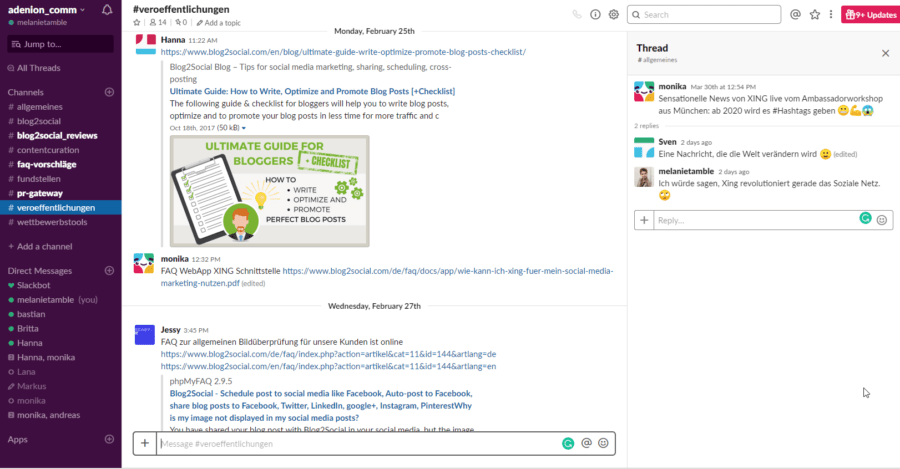
Slack chat tool for fast and easy communication with remote working teams
Slack gives teams a shared workspace where conversations stay organized and accessible from anywhere and on every device. It is much faster than email for everyday coordination and can also be connected with other productivity tools to make workflows even smoother.
We use Slack to create separate channels for products, topics, and campaigns. This helps us share current developments, collect reading material for curation, discuss ideas, and coordinate directly with individual team members or the whole team.
The messaging app enables real-time communication, group chats for specific tasks, and easy sharing of images, links, and documents. That makes it especially useful for editorial coordination, campaign preparation, and quick feedback loops during content production.
2. ClickUp for project and task management (web app)
Who does what, by when, and in which status? Is the post ready for proofreading? Has it been approved for publishing? Are visuals still missing? These are the kinds of questions that can slow down content production when there is no central project overview.
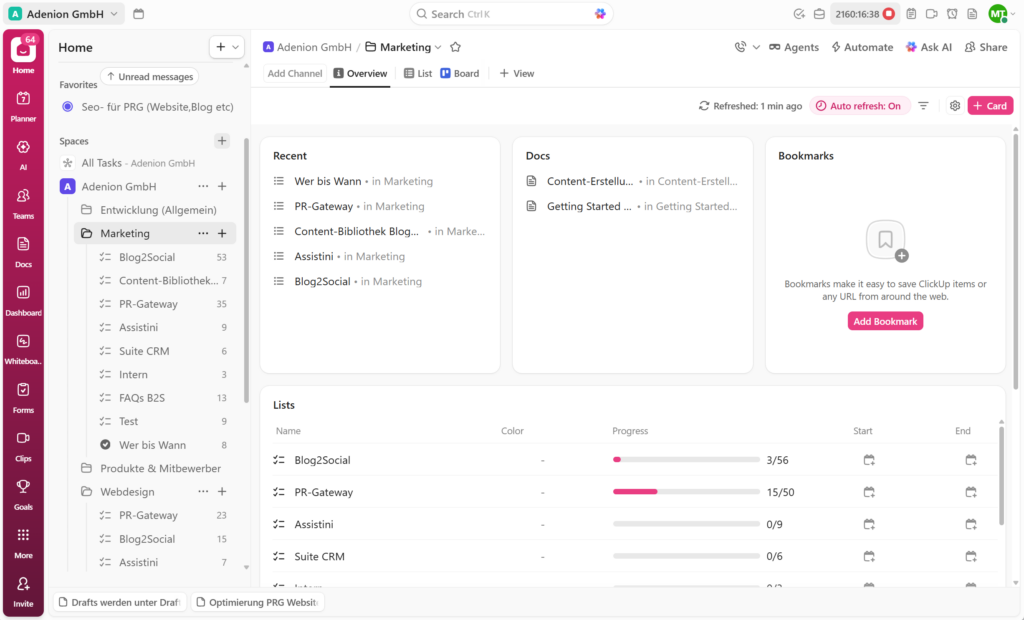
Clickup dashboard
ClickUp helps teams stay organized and get more done in less time. The platform lets you organize, prioritize, and schedule projects on flexible boards, lists, and task views. You can create separate spaces for products, campaigns, or departments and then structure each of them into tasks, subtasks, deadlines, and workflows.
For us, ClickUp is especially useful because it supports collaboration across the full content lifecycle. We can attach documents, collect comments directly on tasks, assign owners, set due dates, and keep approval processes visible for everyone involved.
It also integrates well with tools our team already uses. For example, we connect content assets from Google Drive, OneDrive, and design files from Canva so that drafts and visuals can be reviewed in context.
You can already do a lot with the free version, even when working as a team. If you need more advanced workflow automation, permissions, or integrations, upgrading can be worthwhile.
3. Assistini AI for drafting, editing, and creating publish-ready content (WordPress plugin)
Drafting and approving blog posts in a team can easily become complicated. Many teams work with tools like Google Drive, OneDrive, or Evernote for collaborative drafting. These are excellent choices. But if you want to create and refine content directly in WordPress, a dedicated AI-supported writing plugin can simplify the process significantly.
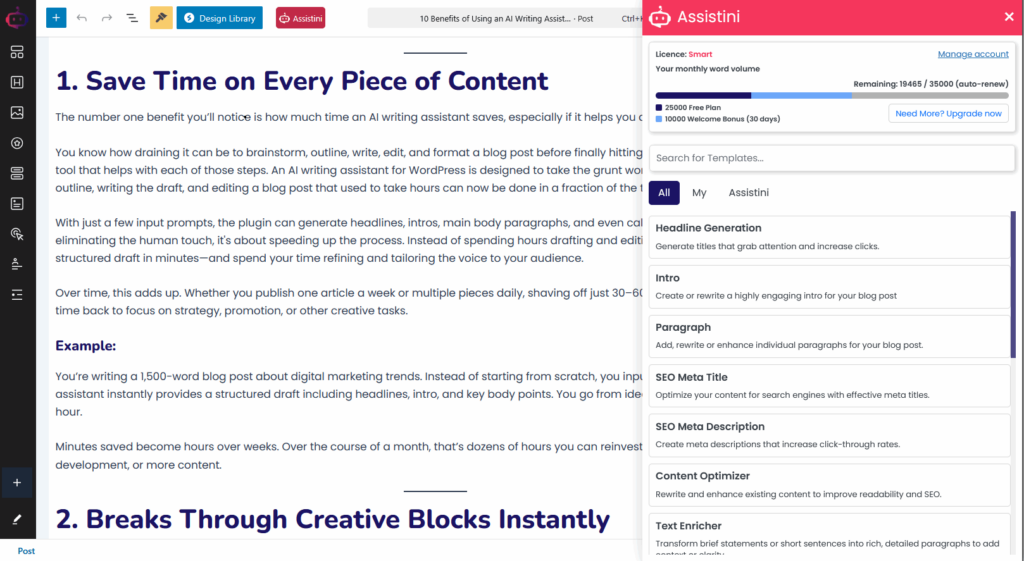
Assistini Editor AI Assistant
Assistini is designed for drafting ideas, editing existing posts, refreshing evergreen content, and creating new content from scratch inside WordPress. This is especially useful when you want to move faster from concept to publish-ready article without switching between too many tools.
The plugin supports AI-assisted content creation, helping you generate drafts, improve structure, and refine wording. It also helps with complementary assets such as matching images and even audio-style content formats like podcasts, which can extend the reach of your blog content into additional channels.
Another practical advantage is that SEO-relevant elements can be prepared directly in the workflow. Assistini helps create SEO-oriented texts and meta information so that the editorial and optimization processes are better connected.
You can also save your own prompts in reusable templates. That makes it easier to preserve your tone of voice, repeat successful content workflows, and complete recurring editorial tasks with much less manual effort.
4. Grammarly for proofreading and language refinement (web app and browser plugin)
Never publish a post before proofreading it. Even the best content idea can lose credibility when the final article contains spelling mistakes, grammar issues, awkward phrasing, or unclear sentences.
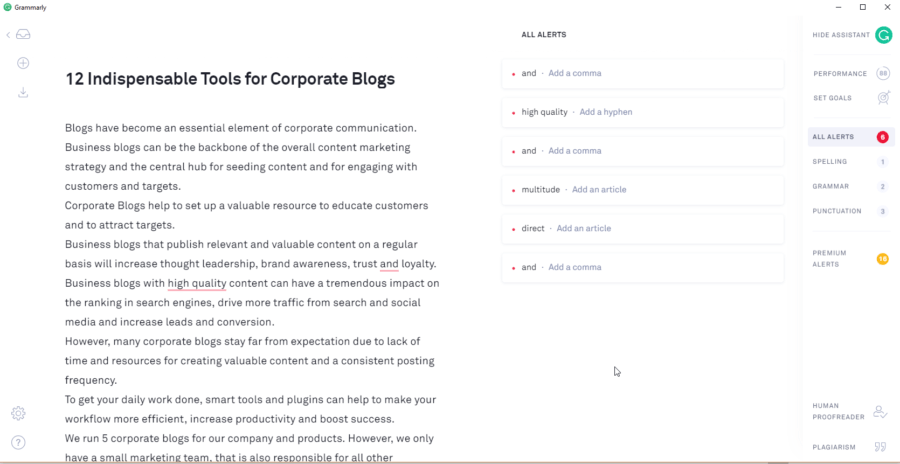
If you do not have a second pair of eyes or a professional proofreader available for every post, Grammarly can be a valuable safety net. The tool checks your text for spelling and grammar issues and also suggests alternative wording to make your writing clearer and more readable.
Screenshot of Grammarly spellchecking and proofreading a text
This is especially helpful when you publish frequently or when several authors contribute to the same blog. Grammarly adds another layer of editorial quality control before you go live.
If you work in WordPress, you can use the browser extension while writing in the editor. If you draft content in Microsoft Word first, Grammarly also integrates there. The browser extension can also support writing workflows in web-based tools like Evernote. Even with AI-supported writing today, Grammarly finds spelling or grammar mistakes that the AI oversees.
The free version already covers many basic proofreading needs and is a good starting point if you want a quick editorial check before publishing.
Extra tip: Also check out the Hemingway App as a free alternative for readability-focused editing. Hemingway highlights lengthy or complex sentences, passive voice, adverbs, and phrases that may make your text harder to read. It is a useful complement when you want to simplify and tighten your writing.
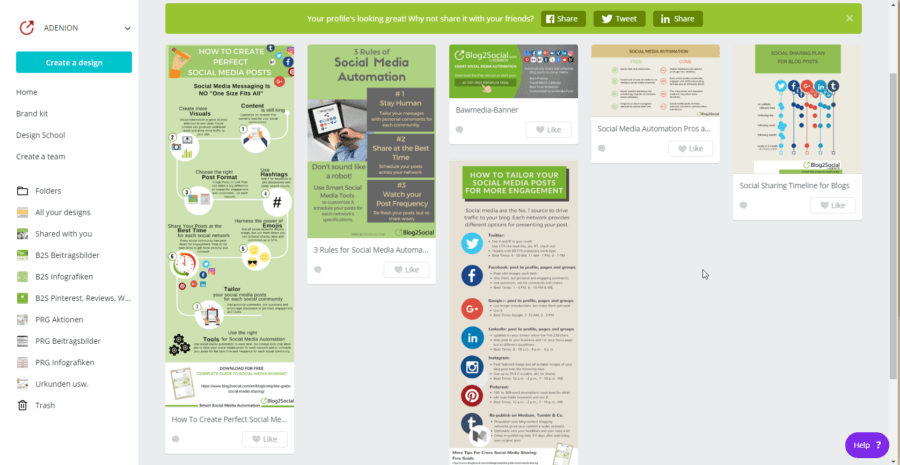
5. Canva for creating visuals and infographics (web app)
Visual content plays an important role in making blog posts easier to consume and more appealing to readers. Images, diagrams, screenshots, and infographics help explain ideas faster and make articles more engaging both on the blog itself and when shared on social media.
Canva for creating images and infographics
Canva has become one of our most useful tools. It makes it easy to create blog graphics, infographics, featured images, and social media visuals with drag-and-drop workflows and a large variety of templates.
Canva offers layouts, photos, icons, and design elements that make it much easier to create visuals that look professional without requiring deep design expertise. This saves a lot of time in everyday editorial work.
Extra tips: For stock photography, we often use Pixabay, Pexels, and Unsplash. For vector-style graphics, Freepik can also be helpful. For simple motion graphics, GIFs, and memes, tools like Giphy, GIFMaker.me, and Flipagram can complement your visual toolbox.
6. Veed.io for creating videos and tutorials (Web app)
Video content can strengthen your blog strategy in several ways. It helps explain processes more clearly, adds another content format to your website, and creates assets you can publish on social channels or video platforms to drive additional visibility.
We regularly create product tutorials and explanatory videos. Veed.io is an easy-to-use tool that helps us produce animated videos, how-to videos, and tutorial content with less technical effort than traditional video editing software.
The tool offers graphics, objects, backgrounds, subtitles, and audio elements that help make videos more appealing and more useful for instruction-based content. This is especially practical for SaaS tutorials, step-by-step product demos, educational clips, and support content.
If you want to repurpose blog content into video, a tool like Veed.io can help turn written knowledge into a more visual format without requiring a full production setup.
Extra tip: For quick screencasts, take a look at iSpring Free Cam. If you want a more advanced desktop video workflow, Camtasia is a more feature-rich option for professional tutorials and product videos.
7. Yoast SEO for search engine optimization (WordPress plugin)
Strong blog content should not only be useful for readers but also easy for search engines to understand. That is where SEO plugins come in. For us, Yoast SEO has long been one of the most helpful plugins for covering important optimization basics directly in WordPress.
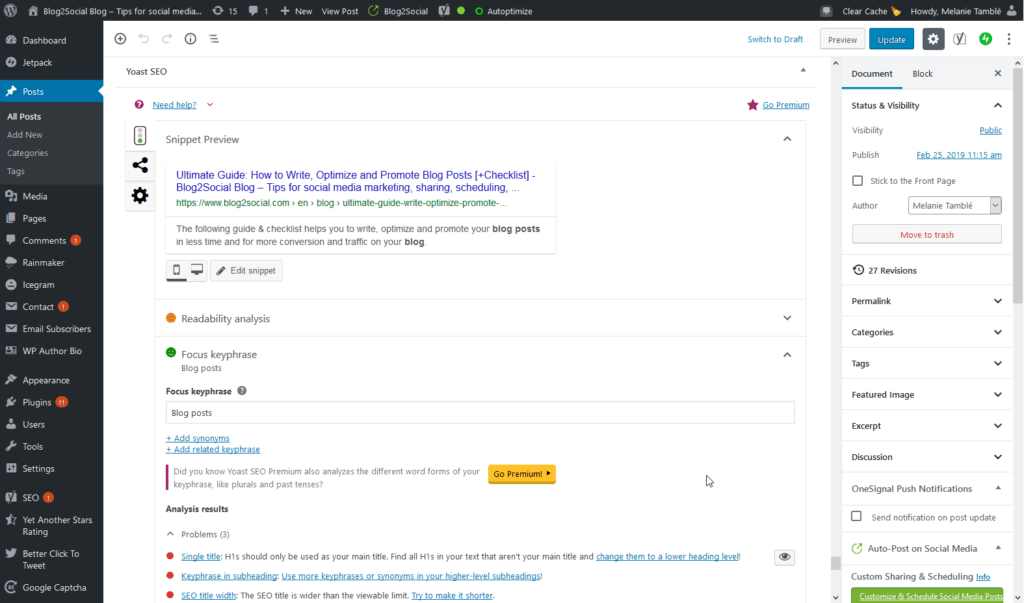
Yoast for SEO Dashboard
Yoast SEO helps authors work on focus keywords, permalinks, meta titles, meta descriptions, image optimization, internal structure, and readability. One of its strengths is that it makes SEO more approachable even for people who are not SEO specialists.
The plugin analyzes your pages and posts and uses clear visual feedback to highlight which areas are already solid and which still need improvement before publishing. This makes it easier to apply consistent SEO basics across your content.
Yoast also supports technical elements such as XML sitemaps and breadcrumbs, which can help improve the structural foundation of your site.
8. Blog2Social for scheduling and sharing your content automatically (WordPress plugin)
Social media is one of the most important channels for promoting blog content and driving traffic back to your website. But if you publish regularly and manage multiple social accounts, posting everything manually can become tedious and very time-consuming.
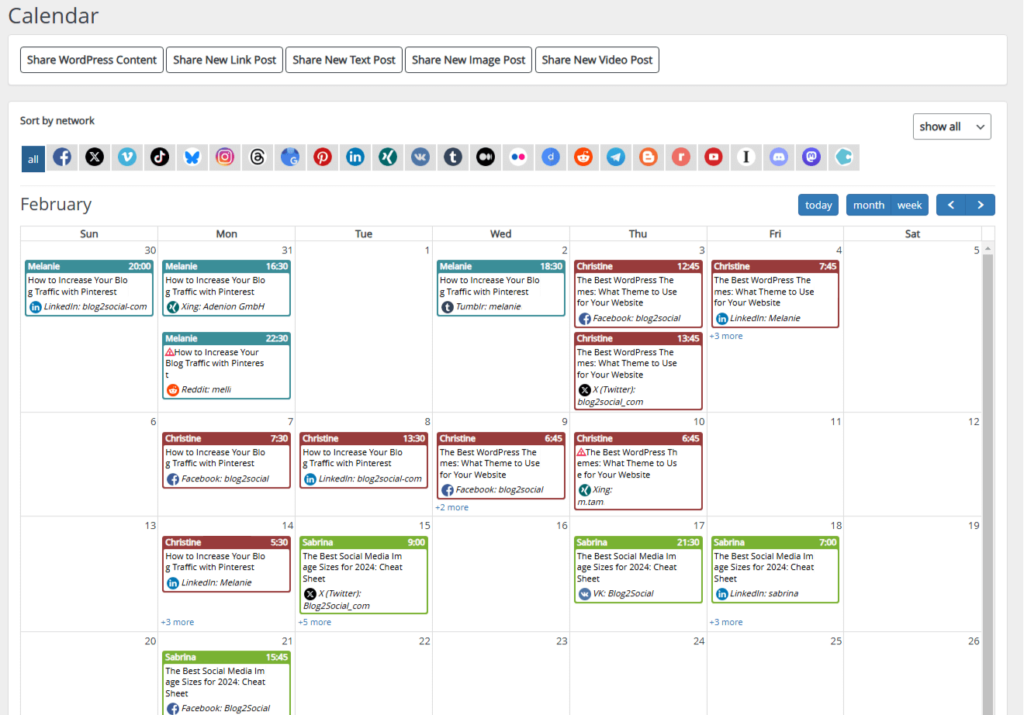
Blog2Social social media calendar
This is where social media automation becomes extremely useful. Blog2Social helps automatically schedule, share, and cross-promote your blog posts across multiple social platforms directly from the WordPress dashboard.
The plugin supports publishing to a wide range of networks and communities. It can auto-post content to networks such as Twitter/X, Facebook, LinkedIn, Instagram, Pinterest, Reddit, Telegram, YouTube, TikTok, Bluesky, Mastodon, Threads, and many others. It also supports republishing to content communities such as Tumblr, Medium or HumHub.
One of the most practical features is that it adapts your blog content into platform-specific post formats. You can auto-post by default or customize each social post manually with individual comments, images, and formats. We usually prefer the customization option because it adds a more human tone and allows us to tailor each post to the audience of the respective network.
You can also schedule posts with suggested best times, define your own posting times, re-share older posts, and manage everything in a social media calendar. That makes it much easier to keep track of upcoming posts and adjust the schedule when needed.
This plugin saves us a significant amount of time because we manage several social channels for each of our blogs and products.
Blog2Social is free to use for basic sharing features, but the premium version is worth testing if you want more elaborate scheduling and customization options.
Extra tip: If you also curate content, links, and visuals from outside your own blog, the Blog2Social Web App is also worth a look.
9. Icegram for opt-ins, popups, and lead generation (WordPress plugin)
Business blogging is not only about publishing useful content. It is also about turning traffic into leads, subscribers, and eventually customers. One of the most effective ways to do this is to capture email addresses and create meaningful conversion opportunities within your content.
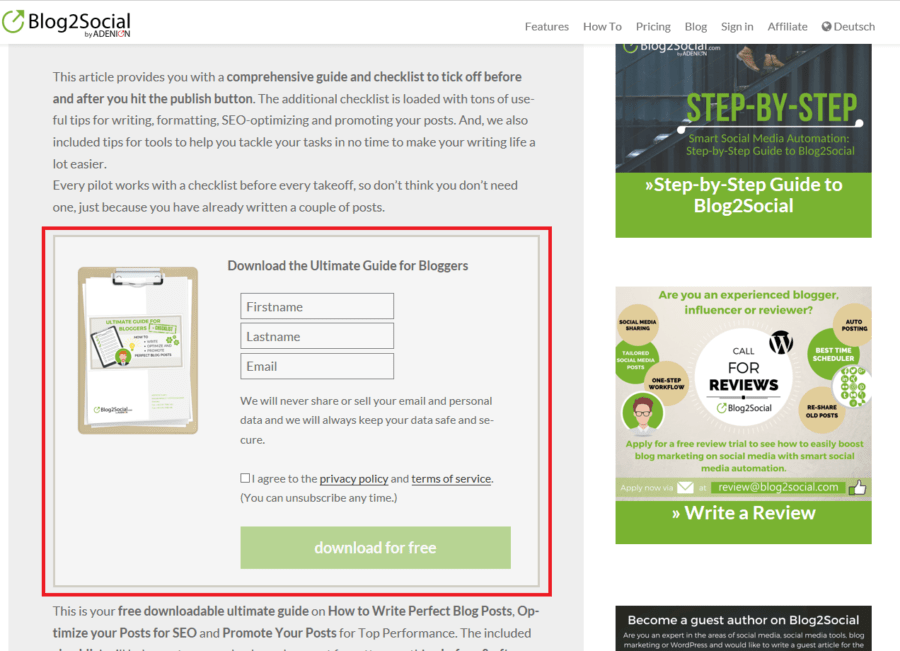
Icegram Form within a Blogpost
Icegram provides a practical toolkit for creating popups, welcome bars, CTA elements, and opt-in forms. The plugin helps us build email subscription forms and lead generation elements in a way that is easy to integrate into our blog workflow.
You can create different opt-in formats, use CTA buttons to guide visitors to relevant pages, and show forms to targeted audiences. This gives you more control over how and where you convert blog readers into subscribers or leads.
The plugin also integrates with common email marketing services such as MailChimp, Constant Contact, AWeber, Campaign Monitor, GetResponse, and others. That makes it easier to connect your blog directly with your broader email marketing workflow.
The free version already covers many useful basics. If you need more advanced options such as split testing, geo-targeting, or more elaborate form designs, the premium version adds more flexibility.
10. Google Analytics for monitoring performance and results (web app)
Content marketing without analytics is guesswork. To understand whether your blog content actually performs, you need data about traffic sources, user behavior, top landing pages, and conversions.
We primarily use Google Analytics to track and report blog traffic. It helps us evaluate which blog posts attract visitors, how users move through the site, how long they stay, and which pages contribute to conversions.
This kind of insight makes it much easier to identify strong posts, weak posts, successful traffic sources, and content gaps. It also helps you understand where visitors drop off and which content paths lead to engagement or sign-ups.
Google Analytics also offers more advanced reporting options, including audience segmentation and goal tracking, which can support more strategic content decisions as your blog grows.
What these tools cover across your full blogging workflow
One reason these tools work well together is that they support different stages of the same editorial process:
communication and coordination: Slack
project and editorial management: ClickUp
drafting, content refreshes, and content production: Assistini
proofreading and readability: Grammarly, Hemingway App
visual content and infographics: Canva, Pictochart, Easi.ly
video tutorials and repurposing: Veed.io, iSpring Free Cam, Camtasia
SEO basics and keyword optimization: Yoast SEO, Google Keyword Planner, Keywordtool.io, WordStream
social media sharing and automation: Blog2Social
lead generation and subscriptions: Icegram
performance measurement: Google Analytics
That is also an important takeaway: there is usually no single “best blogging tool.” What matters is building a workflow where the tools complement each other and support the practical realities of your team.
Wrap up: 10 proven tools and plugins for business blogs
There are thousands of tools and plugins that promise to simplify blogging, marketing, and content workflows. But not every tool fits every team, and not every feature is equally useful in practice.
The tools in this list have proven especially helpful for us because they support real everyday tasks: team communication, planning, content creation, proofreading, design, video, SEO, social media automation, lead generation, and analytics.
If you run a business blog, the goal is not to collect as many tools as possible. The goal is to create an efficient, repeatable workflow that helps you publish useful content consistently and get measurable results from it.
FAQ: business blogging tools and plugins
The most important questions about choosing and using blogging tools answered in a compact format.
Do I need all 10 tools to run a successful business blog? +
No. Most teams start with a smaller stack and expand over time. The best setup depends on your workflow. A practical starting point is usually one tool for communication, one for project management, one for SEO, one for social sharing, and one for analytics.
Which blogging tool saves the most time? +
That depends on where your bottleneck is. For some teams, project tools like ClickUp save the most coordination time. For others, tools like Assistini or Blog2Social have the biggest effect because they speed up content production and promotion.
Are free versions enough for business blogging? +
In many cases, yes. Several tools on this list offer free plans or free plugin versions that are already useful for small teams and growing blogs. Premium versions become more relevant when you need advanced integrations, automation, analytics, or collaboration features.
What is the best blogging tool stack for WordPress? +
A strong WordPress-centered setup could include Assistini for content creation, Yoast SEO for optimization, Blog2Social for social sharing, Icegram for lead generation, and Google Analytics for reporting. Add Slack and ClickUp if your workflow includes team collaboration and editorial planning.
BLOG CHECKLIST
Final business blog workflow checklist
Use this checklist before publishing and promoting your next post to make sure your workflow is structured, efficient, and result-oriented.
Step 1
Planning and coordination
Make sure responsibilities, deadlines, and editorial assets are organized.
Step 2
Content creation and quality
Make sure the article is useful, clear, polished, and aligned with your editorial standards.
Step 3
Optimization and publishing
Make sure the post is ready for search, social sharing, and publishing.
Step 4
Conversion and analysis
Make sure the post does not just attract traffic but also supports business results.
Melanie Tamblé is co-founder and co-CEO of Adenion GmbH. She is an experienced expert in content marketing and social media. Adenion GmbH specializes in online services and tools for bloggers, businesses and agencies of any size to support their online marketing and content seeding tasks on the web.
Blog2Social as WordPress Plugin and WebApp enable fast and easy auto-posting, scheduling and cross-promotion of blog posts, articles, links, images, videos and documents across multiple social media sites. Social media posts will be automatically turned into a customized format for each social platform and auto-scheduled for the best time. Social media post can be previewed and tailored with individual post formats, images or personal comments – all in one easy step.
About the author
Melanie Tamblé
Melanie Tamblé is co-founder and co-CEO of Adenion GmbH. She is an experienced expert in content marketing and social media.
Adenion GmbH specializes in online services and tools for bloggers, businesses and agencies of any size to support their online marketing and content seeding tasks on the web. Blog2Social as WordPress Plugin and WebApp enable fast and easy auto-posting, scheduling and cross-promotion of blog posts, articles, links, images, videos and documents across multiple social media sites.
Social media posts will be automatically turned into a customized format for each social platform and auto-scheduled for the best time. Social media post can be previewed and tailored with individual post formats, images or personal comments - all in one easy step. View all posts by Melanie Tamblé
16 thoughts on “10 Proven Tools and Plugins for Corporate Blogs in 2026 to Streamline Workflows and Boost Results”
Most of listed plugin I already use on my website ??
Hi, Good Collection of plugins here. I would like to suggest you one WordPress plugin for blogs which is Blog Designer – WordPress Plugin. This plugin allows you to modify your blog layout and design. It has features such as Multiple Post Category Selection, Multilingual Translation Ready, Show/Hide Feature, Fully Responsive, etc. Visit here: https://goo.gl/1iA433
Hello Michael, We are happy to hear that you like our tool and plugin list. Thank you for suggesting another interesting tool. We will take a look at it.
Hi, i absolutely got tons of value from your post. Please i have 2 quick questions. 1. What is the number of plugins every blogger shouldn’t exceed? I currently have about 18 installed, would you consider that number outrageous. Please could you also check out my site and offer me your advice? 2. Your font is really beautiful. would you suggest plugins that would give me beautiful fonts just like yours?
We´re happy to hear that you like this article and the information provided to you! Thank you very much for your interesting questions.
Concerning the number of plugins for a blog one can’t simply say what the best number is. This primarily depends on the strategy behind your blog and the goals you want to achieve with it.
Thanks for sharing the best tips about SEO in your article. It really helps those who are struggling with SEO Services for their business. The content is very informative.
Thank you for your kind feedback. We’re glad to hear that you find our content informative and helpful for businesses struggling with SEO. Feel free to check back for more content like this.
To provide the best experiences, we use technologies like cookies to store and/or access device information. Consenting to these technologies will allow us to process data such as browsing behavior or unique IDs on this site. Not consenting or withdrawing consent, may adversely affect certain features and functions.
Functional Always active
The technical storage or access is strictly necessary for the legitimate purpose of enabling the use of a specific service explicitly requested by the subscriber or user, or for the sole purpose of carrying out the transmission of a communication over an electronic communications network.
Preferences
The technical storage or access is necessary for the legitimate purpose of storing preferences that are not requested by the subscriber or user.
Statistics
The technical storage or access that is used exclusively for statistical purposes.The technical storage or access that is used exclusively for anonymous statistical purposes. Without a subpoena, voluntary compliance on the part of your Internet Service Provider, or additional records from a third party, information stored or retrieved for this purpose alone cannot usually be used to identify you.
Marketing
The technical storage or access is required to create user profiles to send advertising, or to track the user on a website or across several websites for similar marketing purposes.







Most of listed plugin I already use on my website ??
I’m very happy to see this list
Hello Olenna,
Thanks! We are very happy to hear that you too like the plugins we chose 🙂
Best regards,
Britta
Hi,
Good Collection of plugins here.
I would like to suggest you one WordPress plugin for blogs which is Blog Designer – WordPress Plugin.
This plugin allows you to modify your blog layout and design.
It has features such as Multiple Post Category Selection, Multilingual Translation Ready, Show/Hide Feature, Fully Responsive, etc.
Visit here: https://goo.gl/1iA433
Hello Michael,
We are happy to hear that you like our tool and plugin list.
Thank you for suggesting another interesting tool. We will take a look at it.
Kind regards
Bastian
Hi, i absolutely got tons of value from your post. Please i have 2 quick questions.
1. What is the number of plugins every blogger shouldn’t exceed? I currently have about 18 installed, would you consider that number outrageous. Please could you also check out my site and offer me your advice?
2. Your font is really beautiful. would you suggest plugins that would give me beautiful fonts just like yours?
Hello Suresh,
We´re happy to hear that you like this article and the information provided to you!
Thank you very much for your interesting questions.
Concerning the number of plugins for a blog one can’t simply say what the best number is. This primarily depends on the strategy behind your blog and the goals you want to achieve with it.
On the Blog2Social website you will find some useful information about useful plugins for setting up a successful blog:
https://www.blog2social.com/en/blog/15-basic-plugin-tips-to-kickstart-your-blog-and-boost-productivity/
If you want more information about themes or fonts, I like to recommend to you the overview of top blogs for WordPress:
https://www.blog2social.com/en/blog/top-blogs-around-wordpress/
On this blogs you will find everything around WordPress and blogging.
Kind regards
Bastian from Blog2Social Team
This is a very useful post. Thanks for sharing the blog.
Thank you very much for your comment, we are happy to hear you like this article
Thanks for sharing the tips on social media marketing. These are very useful.
Hello ramakrishnan,
Thank you so much for your comment! Great to hear you like our article and the tips we provide.
Thanks a ton sharing the tips related to SMM. These are very useful. Will keep sharing.
Hello Shweta,
You are welcome ! Its always great to hear we can help people with the information we provide.
Thank you so much for sharing 🙂
Kind Regards
Bastian
This is a very useful post. Thanks for sharing the blog.
Hello Jason,
Thank you very much for your awesome feedback 🙂 . It’s great to hear that you find the post useful.
Thanks for sharing the best tips about SEO in your article. It really helps those who are struggling with SEO Services for their business. The content is very informative.
Thank you for your kind feedback.
We’re glad to hear that you find our content informative and helpful for businesses struggling with SEO.
Feel free to check back for more content like this.
All the best and have a great day!
Sabrina