
The First Comment Strategy enhances social media posts by keeping captions clean, boosting engagement, improving visibility, and encouraging meaningful interaction. Learn about how to apply a First Comment strategy to your social media posts to boost visibility and engagement.
What Is the First Comment Strategy?
The First Comment Strategy is a social media tactic where you publish your main post without links, hashtag blocks, or secondary information and instead place them in the first comment immediately after publishing.
The goal is simple:
- Keep your caption clean
- Improve engagement signals
- Increase visibility
- Encourage interaction
This strategy is commonly used on platforms like:
- TikTok
- Threads
- Bluesky
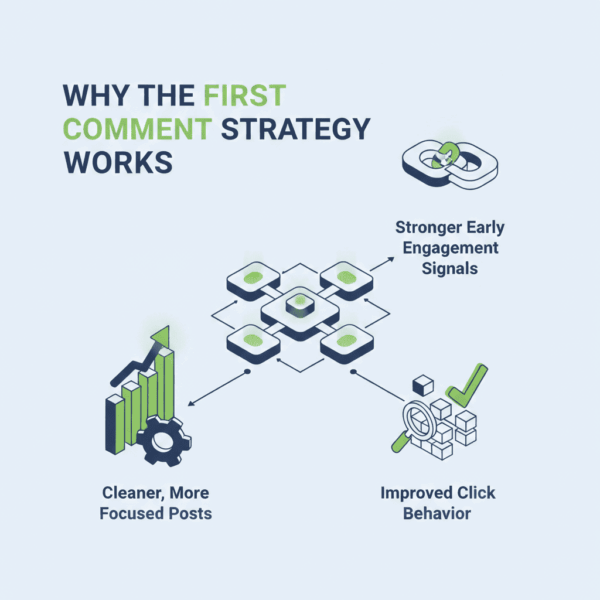
Why the First Comment Strategy Works
1. Cleaner, More Focused Posts
Long captions with:
- Multiple hashtags
- Tracking links
- Extended CTAs
can interrupt readability.
By moving these elements into the first comment, your main post becomes:
- Clear and structured
- Easier to scan
- More professional
Clean formatting increases the likelihood that users read your entire post.
2. Stronger Early Engagement Signals
Engagement in the first minutes after publishing plays a critical role in distribution.
When you immediately add a first comment, you:
- Create instant interaction
- Increase comment count
- Encourage users to open the discussion
Opening and interacting with comments sends positive signals to the platform.
3. Improved Click Behavior
On some platforms, external links in captions may reduce reach or distract from the core message.
Placing the link in the first comment:
- Keeps the post value-driven
- Builds curiosity
- Encourages active engagement before clicking
Users who intentionally open the comment section are already more engaged.
4. Better Conversation Quality
The first comment does not always have to contain a link.
It can also:
- Ask a strategic follow-up question
- Add context not included in the post
- Share a supporting statistic
- Provide a resource or checklist
This transforms a broadcast post into a dialogue.
Platform-Specific Applications
Instagram First Comment Strategy
On Instagram, this strategy is especially effective.
Best use cases:
- Move hashtag blocks into the first comment
- Keep captions storytelling-focused
- Add a follow-up question in the first comment
Since links are not clickable in captions and comments, the first comment supports your “Link in bio” strategy. Or share another specific URL in the first comment.
LinkedIn First Comment Strategy
On LinkedIn, native posts often perform better than posts that immediately push external links.
Best use cases:
- Share insights in the main post
- Add the link in the first comment
- Use the comment to spark discussion
This keeps the post value-driven and discussion-oriented.
Facebook First Comment Strategy
On Facebook:
- Test link placement (caption vs. first comment)
- Use the first comment for structured add-ons
- Add limited, relevant hashtags
Testing is key, as performance can vary by audience.
TikTok First Comment Strategy
On TikTok, links are less relevant than engagement.
Best practices:
- Pin your own first comment
- Add clarification or context
- Ask viewers a direct question
Pinned comments guide the conversation and increase dwell time.
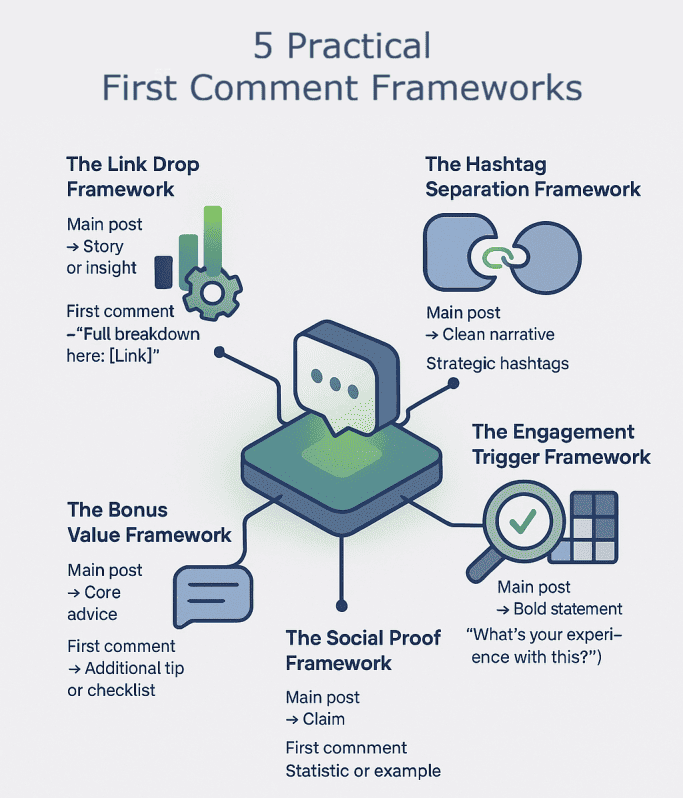
5 Proven First Comment Frameworks – Explained in Detail
To unlock the full potential of the First Comment Strategy, you need structure. The first comment should strategically enhance your post — not repeat it.
Here are five proven frameworks you can apply immediately to increase reach, engagement, and clicks.
1. The Link Drop Framework
Goal: Increase clicks without cluttering your caption
Main post → Story, insight, or problem
First comment → Value-driven link with a clear benefit statement
How it works
Your main post delivers real value on its own: a short insight, a lesson learned, a tip, or a mini-guide. It stands independently — without an external link.
The first comment then introduces the link with a clear reason to click.
Example
Post:
“Many businesses lose reach because they place external links directly in their caption. There’s a simple structure that can significantly increase engagement …”
First comment:
“Here’s the full step-by-step breakdown: [Link]
You’ll also learn which platform is most sensitive to external links.”
Why it works
- The post remains value-driven.
- The link feels natural, not promotional.
- Users intentionally open the comments — increasing interaction signals.
2. The Hashtag Separation Framework
Goal: Improve readability and visual clarity
Main post → Clean, focused caption
First comment → Strategic hashtag set
How it works
Instead of adding 10–20 hashtags to the end of your caption, you move them into the first comment.
Example
Post:
“3 ways to sustainably increase your organic reach in 2026 …”
First comment:
#SocialMediaStrategy #ContentMarketing #LinkedInTips #InstagramGrowth #OrganicReach
Why it works
- Your caption stays clean and professional.
- The message remains the focal point.
- Hashtags are still searchable and effective.
This method is especially common on Instagram.
3. The Engagement Trigger Framework
Goal: Increase comments and spark discussion
Main post → Strong statement, opinion, or bold claim
First comment → Direct follow-up question
How it works
You make a clear statement in your main post. The first comment then invites readers to respond in a structured way.
Example
Post:
“Reach is not the most important metric in social media marketing — relevance is.”
First comment:
“What matters more in your strategy right now: reach or relevance — and why?”
Why it works
- The first comment directs the conversation.
- Readers feel personally invited to respond.
- The barrier to commenting is lowered.
This framework performs particularly well on LinkedIn and Facebook.
4. The Bonus Value Framework
Goal: Increase perceived value and dwell time
Main post → Core advice or key message
First comment → Extra tip, checklist, or structured summary
How it works
Your main post delivers the primary insight. The first comment adds practical, actionable value that enhances the post.
Example
Post:
“Here’s how to structure your social media posts for higher engagement.”
First comment:
“Bonus checklist:
✔ Short paragraphs
✔ One clear core message
✔ One direct question at the end
Save this for your next post.”
Why it works
- The post gains a second layer of depth.
- Readers intentionally open the comments.
- Your content feels structured and premium.
This framework works especially well for educational content, mini-guides, and recurring tip formats.
5. The Social Proof Framework
Goal: Increase credibility and authority
Main post → Claim, result, or insight
First comment → Data point, statistic, or case example
How it works
You present a statement in your main post. The first comment supports that claim with evidence.
Example
Post:
“With the right structure, you can significantly increase engagement.”
First comment:
“Case example:
After switching to the First Comment Strategy, one client increased their comment rate by 37% within four weeks.”
Why it works
- Your statement becomes more credible.
- Numbers and examples strengthen persuasion.
- The comment adds substance instead of repetition.
This framework is particularly powerful for expert positioning and B2B communication on LinkedIn.
Which Framework Should You Use?
It depends on your objective:
- More clicks? → Link Drop
- Cleaner visuals? → Hashtag Separation
- More comments? → Engagement Trigger
- Higher perceived value? → Bonus Value
- Stronger authority? → Social Proof
You can also combine frameworks — for example, Bonus Value + Engagement Trigger.
The key takeaway:
The first comment is not an afterthought.
It is a strategic extension of your post.
When used intentionally, it becomes a powerful lever for increasing reach, engagement, and overall impact.
Common Mistakes to Avoid
- Posting the comment too late
- Overloading with hashtags
- Repeating the same content
- Using it only for aggressive promotion
The first comment must enhance the post, not duplicate it.
Implementing the First Comment Strategy with Social Media Automation
The First Comment Strategy works best when it’s applied consistently—across platforms, post types, and campaigns. That’s exactly where Blog2Social becomes a strategic advantage: it helps you turn a “nice idea” into a repeatable workflow, without adding manual effort to every single post.
1) Keep your captions clean—without losing key details
A common challenge with the First Comment Strategy is deciding what belongs in the main post and what should be moved to the first comment. With Blog2Social, you can separate these two layers intentionally:
- Main caption: focus on your message, hook, and the value for your audience
- First comment: place the “supporting elements” such as links, hashtag sets, resources, or a follow-up question
This keeps your posts readable and professional while still making sure the important extras are visible and easy to find.
2) Apply the strategy consistently across your channels
The real benefit isn’t using the first comment occasionally—it’s using it as a standard format. Blog2Social helps you build that consistency by allowing you to prepare your posting structure in advance and reuse it across networks where first comments are supported (currently Facebook, Instagram, LinkedIn, X, and Bluesky).
That means your team (or you) won’t have to remember “Did we add the first comment?” every time. The strategy becomes part of your publishing routine, not an extra task.
3) Speed up planning for campaigns and recurring content
The First Comment Strategy is especially effective for recurring formats such as:
- weekly tips and mini-guides
- blog post promotions
- product updates
- event announcements
- lead magnets and downloads
With Blog2Social, you can plan these formats with a stable structure: one clean post + one strategic first comment. Over time, this creates a recognizable style your audience gets used to—making your content easier to consume and more likely to drive interaction.
4) Make your first comment more useful than “here’s the link”
A high-performing first comment is rarely just a link. Blog2Social supports adding real value into that space, for example:
- a short “what you’ll get” teaser before the link
- a checklist or key takeaways
- a follow-up prompt that sparks replies
- a compact hashtag set for discoverability
This turns the first comment into an engagement tool, not just a storage space for extras.
5) Reduce manual work while improving timing
A big reason the First Comment Strategy fails in practice is timing: the comment is posted too late, forgotten, or added inconsistently.
With Blog2Social, the first comment is published right after your post goes live. Strategically, this matters because you get the best of both worlds:
- your post launches with a clean caption
- your first comment appears immediately, supporting early engagement and clicks
6) Scale the strategy with reusable structures
If you manage multiple content sources (blog posts, pages, product links), Blog2Social can help you scale by using placeholders (like title, excerpt, keywords, URL). Strategically, this enables a “template thinking” approach:
- Keep your caption structure consistent
- Let the variable parts (link, topic, keywords) update automatically per post
- Maintain quality without rewriting everything from scratch
This is especially helpful for businesses and agencies that publish frequently and want every post to follow proven best practices.
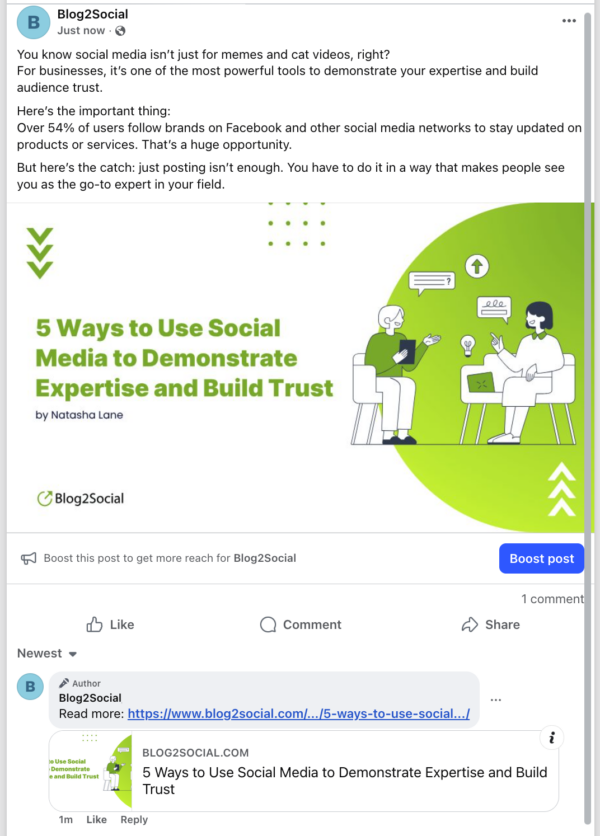
Example: Facebook Post with First Comment field in the Blog2Social preview editor

A simple strategic workflow you can adopt
If you want a practical way to apply this immediately, use this publishing format:
Main post
- Hook (1 sentence)
- Value (2–5 short lines)
- Soft CTA (“Share your experience” / “Which option would you choose?”)
First comment
- Bonus detail + link or resource
- Optional: compact hashtag set
- One question to invite replies
Blog2Social helps you apply this format reliably—so the First Comment Strategy becomes part of your content system, not a manual habit you have to maintain.
If you want, I can also add 3–5 ready-to-use first comment templates (for blog posts, lead magnets, product updates, and tips) that match the tone of the article. allows you to scale the First Comment Strategy efficiently across multiple posts and networks.
Final thoughts on the first comment strategy
The First Comment Strategy is a structural optimization that improves:
- Readability
- Engagement
- Conversation quality
- Click behavior
It requires no advertising budget and no complex growth hacks.
It is simply a smarter way to structure your posts.
When implemented consistently—and supported by scheduling tools—it becomes a powerful part of a professional social media engagement strategy.

Melanie Tamblé is co-founder and co-CEO of Adenion GmbH. She is an experienced expert in content marketing and social media.
Adenion GmbH specializes in online services and tools for bloggers, businesses and agencies of any size to support their online marketing and content seeding tasks on the web.
Blog2Social as WordPress Plugin and WebApp enable fast and easy auto-posting, scheduling and cross-promotion of blog posts, articles, links, images, videos and documents across multiple social media sites.
Social media posts will be automatically turned into a customized format for each social platform and auto-scheduled for the best time. Social media post can be previewed and tailored with individual post formats, images or personal comments – all in one easy step.
About the author