
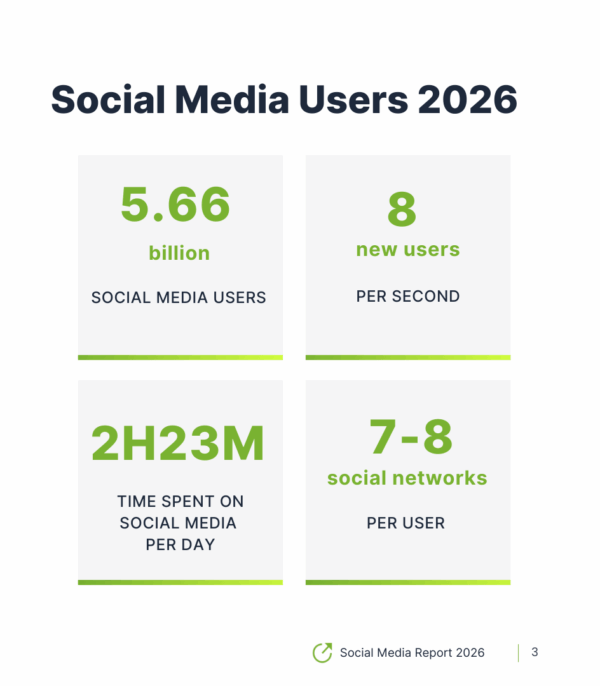
The social media world has reached new maturity in 2026: 5.66 billion social media users – that’s 69% of the global population – use social networks. Eight new users join every second, and the average user spends 2 hours and 23 minutes daily across 7–8 different networks.
This comprehensive report shows you the current monthly active users (MAU), demographics, usage behaviors, and 2026 trends – perfect for your marketing strategy, content planning, and audience targeting.
Get the complete Social Media Report 2026 now – featuring the latest user statistics, trends & tips!

The Social Media Landscape 2026: The Big Numbers
Social media is no longer a trend – it’s a core part of digital life. As of early 2026, there are an estimated 5.66 billion social media users worldwide, representing roughly 69% of the global population. Over the previous 12 months, social platforms added around 259 million new user identities, an annual growth rate of about 4.8%.
People spend an average of about 2 hours and 23 minutes per day on social platforms and are active on roughly 7–8 different networks.
Ranking: Monthly Active Users (MAU) 2026
Below is an overview of the largest global platforms by (approximate) monthly active or regularly active social media users in 2026:
| Platform | Monthly active users (2026) | Diff. 2025-2026 |
|---|---|---|
| 3.22 billions | +2.2% | |
| YouTube | 2.85 billions | +5.5% |
| 2.2 billions | +10% | |
| TikTok | 1.7 billions | +7.5% |
| 1.0 billions | +8% | |
| X (Twitter) | 660 millions | -5% |
| 520 millions | +4.4% | |
| Threads (Meta) | 380 millions | +20% |
| Discord | 250 millions | +8.5% |
Facebook remains the world’s largest platform with 3.22 billion MAU. YouTube follows with 2.85 billion as the video heavyweight, while Instagram (2.20 billion) and TikTok (1.70 billion) are the most dynamic growth drivers.

Overall, the Meta portfolio (Facebook, Instagram, Threads, WhatsApp) and YouTube continue to dominate reach, while TikTok remains a major driver of growth in attention, engagement, and creator‑led commerce.
Growth Champions: Instagram (+10%), Threads (+9.38%), Discord (+8.70%)
Declines: Reddit, LinkedIn, Pinterest
Global Platform Profiles in 2026:
Facebook: The Established Giant
Facebook remains one of the world’s largest social platforms, with around 3.2 billion monthly active users. While growth has slowed compared to newer entrants, its reach across older demographics and many regions remains unmatched.
Key characteristics:
- Strong in community‑building through groups and events.
- Increasing share of time spent on video formats, especially Reels.
- Important for cross‑generational communication and broad‑reach campaigns.
YouTube: The Video Powerhouse
YouTube, with roughly 2.8 billion active users, is the global reference platform for video content. It covers everything from music and entertainment to education, tutorials, and long‑form commentary.
Key characteristics:
- Massive daily watch time and deep engagement.
- YouTube Shorts serves as a direct competitor to short‑form video apps and drives incremental reach.
- Ideal for evergreen content, how‑to videos, product explainers, and long‑form storytelling.
Instagram: Visual Storytelling and Social Shopping
Instagram hosts around 2.2 billion monthly active users and remains a central hub for visual storytelling and lifestyle content. It combines feed posts, Stories, Reels, and shopping features into a single ecosystem.
Key characteristics:
- Almost entirely mobile usage.
- Reels now represent a major portion of user time and algorithmic reach.
- Strong in influencer marketing, brand building, and in‑app shopping.
TikTok: The High‑Growth Short‑Form Leader
TikTok, with an estimated 1.7 billion users globally, continues to drive the short‑form video revolution. Engagement levels are extremely high, with users often spending well over an hour per day in the app.
Key characteristics:
- Algorithm‑driven feed that surfaces highly engaging content regardless of follower count.
- Particularly strong among Gen Z and younger Millennials.
- Crucial for brand discovery, viral trends, and Creator‑driven campaigns, including social commerce.
Why People Use Social Media 2026
Social media has become the modern search engine: Users research products, tutorials, and inspiration directly on platforms like YouTube, TikTok, and Instagram. The multi‑platform behavior shows that users now assign different roles to different apps – from news and entertainment to product discovery and professional networking.
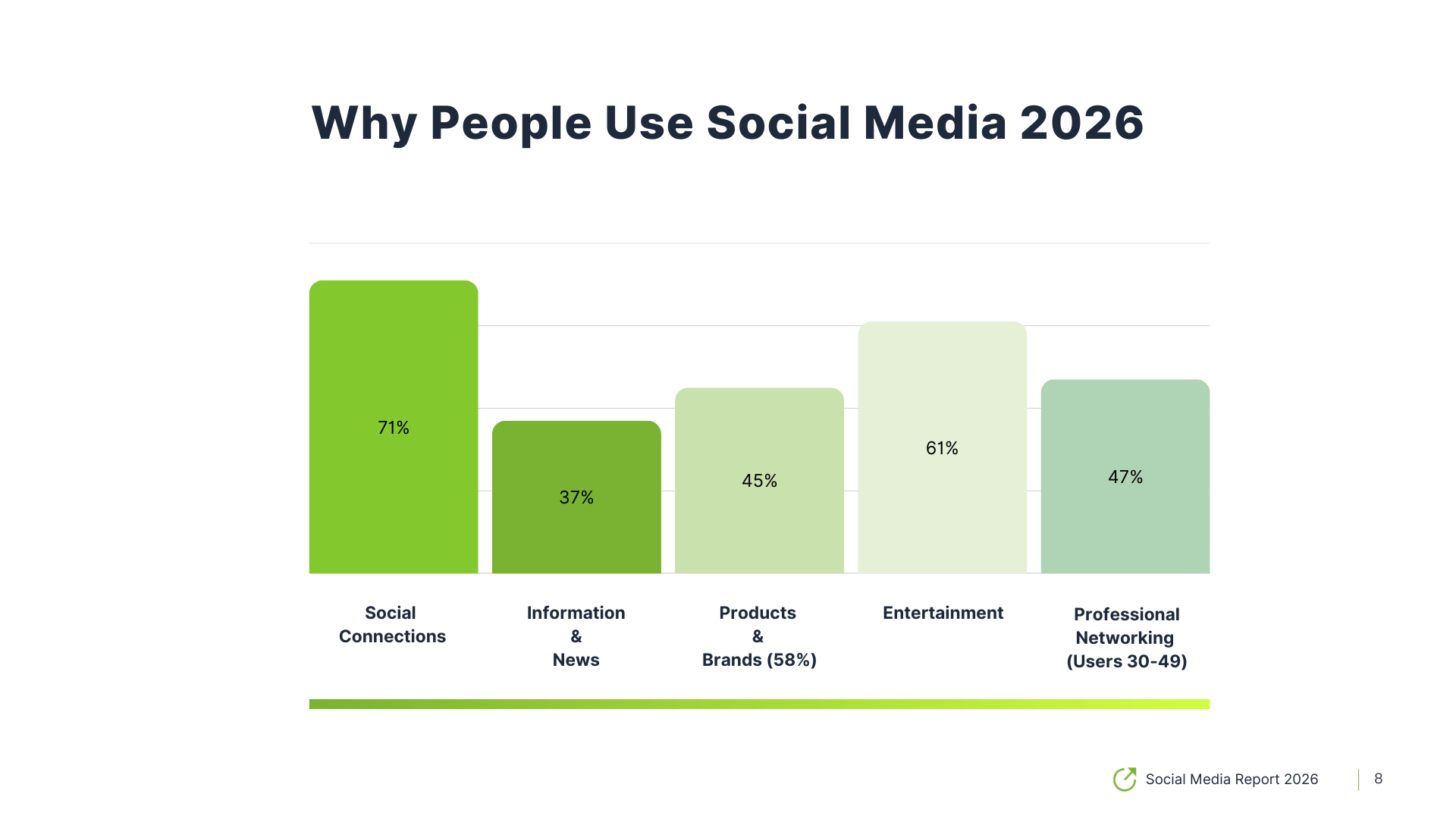
The main motivations are clearly defined by numbers:
- Staying connected: 71%
Users want to maintain relationships with friends, family, colleagues, and communities wherever they are. - Entertainment and inspiration: 61%
Short videos, live streams, memes, stories, gaming content,t and creator‑led formats dominate attention and watch time. - Information and news consumption: 45%
A significant share of adults get news and current affairs updates through social platforms, following both media brands and individual experts. - Product discovery and research: 37%
A large proportion of internet users rely on social channels to discover new brands, compare products, read reviews, and watch product demos before buying. - Career and professional networking: 47%
Professionals use dedicated platforms to build personal brands, share expertise, network, and stay up to date on industry trends.
Who Uses Which Platform: A Demographic Breakdown of Active Social Media Users
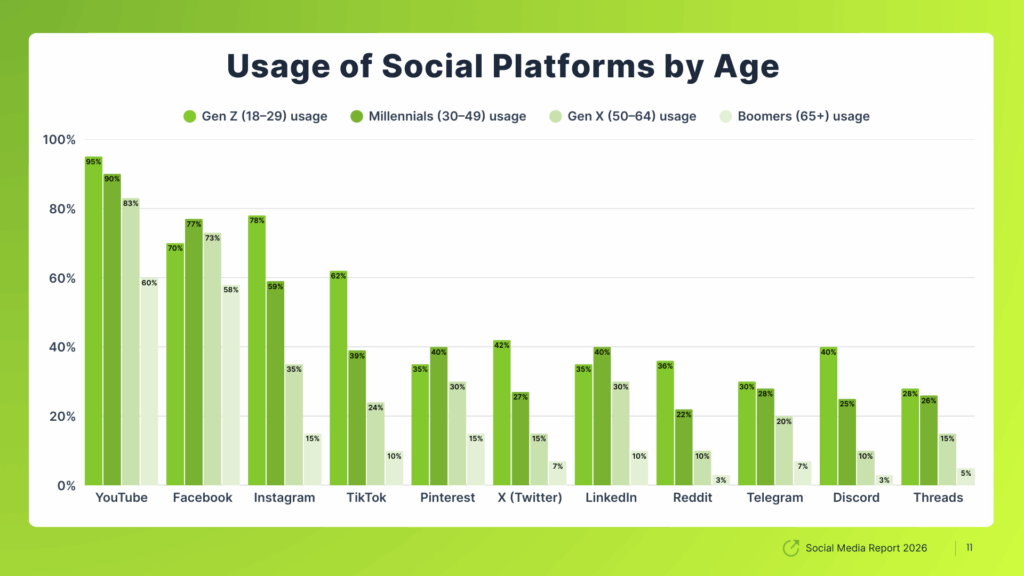
Generational Usage and Platform Preferences of Social Media Users
Different age groups use social platforms in distinct ways and tend to cluster around particular apps and formats:
- Gen Z (approx. 11–26 years): 30%
- Make up a large share of global social users.
- Prefer highly visual, mobile‑first, short‑form content.
- Spend most of their time on platforms centered on video, trends, and creators.
- Millennials (approx. 27–42 years): 35%
- Use social media both socially and professionally.
- Active across visual platforms, video apps, and professional networks.
- Open to social commerce, brand content, and educational formats.
- Gen X (approx. 43–58 years):
- Use social media more for information, news, and professional networking.
- Engage with video, groups, and communities that align with their interests.
- Older users (approx. 59+ years): 9%
- Rely heavily on established, general‑purpose platforms and video.
- Use social media to stay informed and keep in touch with family and friends.
The Universal Giants
These platforms boast the largest user bases and act as the primary “utilities” of the internet.
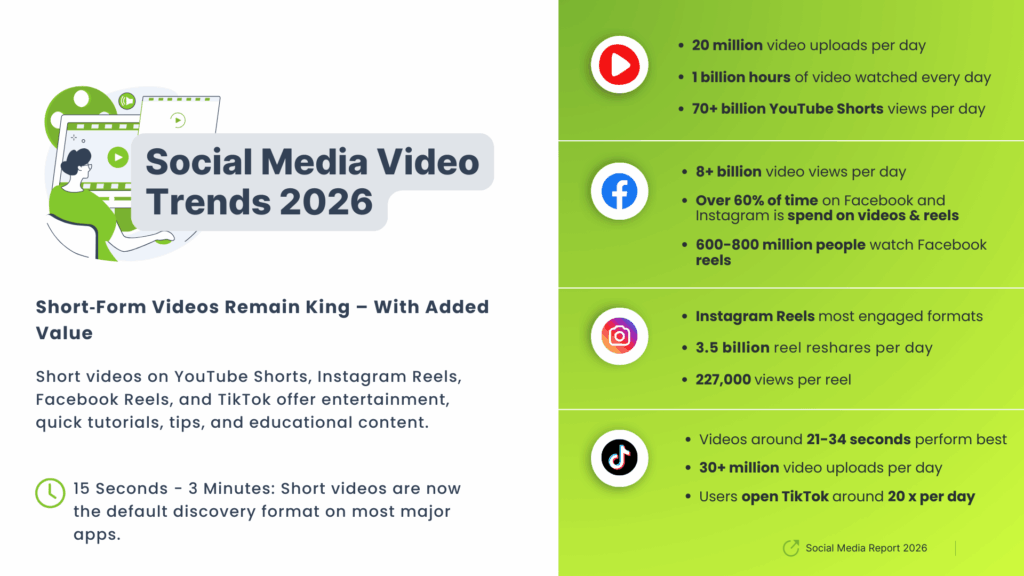
- YouTube: Continues to be the undisputed leader in cross-generational reach. As of 2026, it is the top video platform for all age groups, reaching over 90% of adults under 50. It is increasingly serving as a primary search engine and an educational hub.
- Facebook: Remains the strongest platform for Millennials, Gen X, and Boomers. While Gen Z continues to shift their time elsewhere, Facebook’s “Groups” and “Marketplace” features keep it relevant as a community and utility tool for over 3 billion monthly users.
The Visual & Viral Drivers
These platforms define modern culture through short-form video and high-aesthetic content.
- TikTok: Still heavily skewed toward Gen Z and Gen Alpha, though the “aging up” effect is visible as the 25–34 demographic now represents its largest growth sector. In 2026, TikTok has solidified its role as a discovery engine, with many younger users bypassing Google to search for products and news here.
- Instagram: A staple for Gen Z and Millennials. While there is a significant age gap compared to older users, Instagram’s pivot to “Reels” and social commerce has maintained high engagement. It is currently the preferred platform for brand discovery and shopping inspiration.
- Pinterest: While historically popular with Millennials and Gen X for “planning and inspiration,” 2026 data shows a surprising surge in Gen Z adoption (now nearly 46% of its user base). It remains the go-to space for shopping intent and creative projects.
Social Media Community & Discussion Engines
These platforms prioritize conversation, privacy, and niche interests over “the feed.”
| Platform | Core Audience | Focus |
| Gen Z & Young Millennials | Niche communities & high-trust product reviews. | |
| Discord | Gen Z & Gamers | Real-time chat, private servers, and hobbyist groups. |
| Telegram | Global/Younger | Privacy-oriented communication and large interest channels. |
| Working-age (25–54) | Professional identity, B2B marketing, and “thought leadership.” |
The “Real-Time” Battle: X vs. Threads
The landscape for short-form text and news has become highly fragmented over the last year.
- X (formerly Twitter): Still the “news desk” of the internet, but usage continues a gradual decline. It remains discussion-driven and popular among a younger, news-hungry audience, though it faces heavy competition from growing alternatives.
- Threads: Now in its mature growth stage, Threads is closing the gap with X in daily mobile users. It leans heavily toward the 18–34 demographic and positions itself as a “friendlier” alternative for mobile-first social discourse.
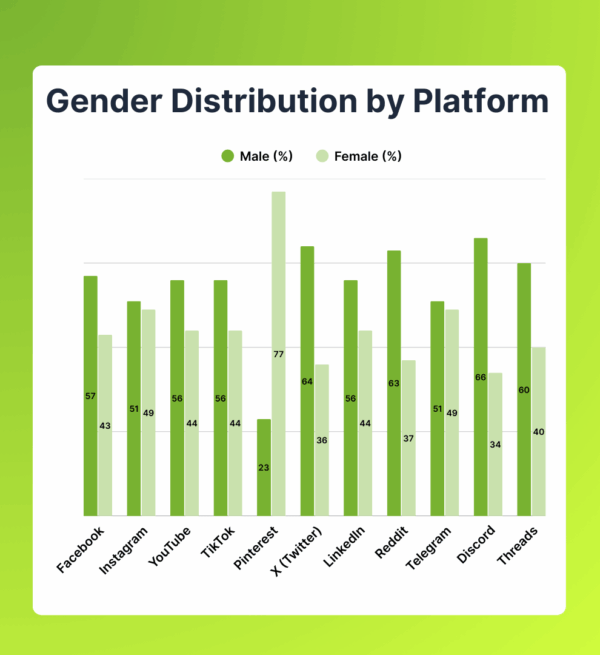
Gender Distribution of Social Media Users Across Social Platforms
Globally, the gender split among social media users is relatively balanced, at roughly 53% male and 47% female. However, individual platforms skew more strongly in one direction:
- Visual inspiration and planning platforms are predominantly female.
- Discussion‑ and forum‑type platforms lean male.
- Professional networks still show a slight male majority.
- Large general‑purpose networks are closer to parity overall.
Understanding how age and gender distributions differ per network helps you decide where to focus your content and ad budgets for specific segments.
The Most Popular Social Networks for Companies
Companies are not using social media “on the side” anymore – these channels are tightly aligned with concrete business goals.

Why these networks are prioritized
Facebook (83%) and Instagram (78%) form the backbone of most companies’ social presence.
- Facebook offers huge reach, diverse formats (posts, Reels, groups, events) and mature ad targeting, making it ideal for broad awareness and community management.
- Instagram is the flagship channel for visual storytelling, influencer collaborations and social commerce, helping brands stage products emotionally and build lifestyle‑driven brand worlds.
LinkedIn (69%) is almost non‑negotiable in B2B, employer branding and recruiting.
Here the focus is less on entertainment and more on expert positioning, thought leadership, and attracting talent, so companies share industry insights, case studies and culture content.
YouTube (53%) acts as a video content hub.
Long‑form explainers, product demos, tutorials and webinars live here and can be discovered via search for years, which gives YouTube a special role in education, onboarding and complex purchases.
TikTok (27%) and X/Twitter (26%) are used more selectively.
- TikTok is favored when brands want to tap into younger audiences, trends and viral reach, but it demands a fast, creative, native content style.
- X/Twitter remains important for real‑time communication – news, commentary, crisis communication, and quick customer support in certain industries.
Threads (12%) is still in an experimental phase for most companies.
Brands are testing it as a text‑ and discussion‑oriented extension of Instagram, but it is rarely a core channel yet.
What goals sit behind this platform mix
Overall, this platform priority supports three main corporate objectives:
- Brand awareness
- Facebook, Instagram, YouTube and TikTok are best for reach and mental availability.
- Visual and video formats (Reels, Shorts, Stories, thumbnails) ensure the brand is repeatedly seen and remembered.
- Recruitment and employer branding
- LinkedIn is the primary driver here, with Facebook and Instagram as supporting stages for behind‑the‑scenes and team stories.
- Companies showcase culture, benefits and career paths to position themselves as attractive employers.
- Customer insights and feedback
- Comments, DMs, reviews, polls and Q&As provide continuous input on products, services and campaigns.
- X/Twitter, Facebook groups, Instagram Stories (polls, question stickers) and community platforms help brands listen and react quickly.
In short, the numbers don’t just show where companies are present – they reflect a deliberate division of roles: broad reach and storytelling on Meta and YouTube, authority and talent attraction on LinkedIn, trend and speed on TikTok and X, and experimentation plus community depth on emerging networks like Threads.
Key Social Media User Trends and Outlook for 2026
Several macro‑trends define the social media environment in 2026:
1. Short-Form Video Dominates
Vertical clips (15 seconds to 3 minutes) are prioritized across all major platforms – Reels, Shorts. Clips around 20-34 seconds perform best on TikTok.
2. Community & Niche Platforms Boom: Creators at the center
Brands increasingly partner with creators, and invest in building their own communities rather than relying solely on algorithmic reach. Threads (380M), Discord (250M), Mastodon and Bluesky show the shift to interest-based, decentralized spaces.
3. AI-Powered Content & Automation
Generative AI supports ideation, content production, localization, captioning, and moderation, while recommendation systems get more personalized.
4. Social Commerce Growth
Purchases move closer to content, with native shops, product tags, and live‑shopping formats gaining traction. In-app purchases and creator commerce expand rapidly.
5. Authenticity Over Polish
Users react more strongly to honest, relatable and behind‑the‑scenes content than to highly polished, traditional ad creatives.
Your Social Media Action Plan for 2026
In this mature but fast‑moving ecosystem, success requires a multi‑platform approach that respects each network’s unique strengths while aligning with overarching goals. Brands that thrive are those that adapt quickly, experiment continuously, and keep genuine, meaningful engagement with their audiences at the center of everything they do.
Match platforms to audience: Use the age/gender matrices to pick your top 3–5 networks
How to Turn Social Media Metrics into Real Results – with Smart Social Media Management
The social media landscape in 2026 demands a strategic, cross-platform approach. Anyone aiming for long-term success needs to stay flexible, continuously adapt, and keep a close eye on emerging trends.
Engagement is the key to growth on social networks – but posting regularly across multiple platforms can eat up countless hours. Time you could be spending far more effectively elsewhere.
With Blog2Social, you can automate your social media planning and save valuable time. Manage all your networks from one central dashboard, schedule posts using the Best Time Manager, and keep everything under control with the social media calendar.
Use your time more wisely – and focus on creating content that truly resonates with your audience.
Looking for deeper insights into this year’s monthly active social media users?
This Social Media Report 2026 is your complete data toolkit – with all charts, numbers, and strategic insights ready for your blog posts, presentations, and client pitches. Download for free!
Get the complete Social Media Report 2026 now – featuring the latest user statistics, trends & tips!

Melanie Tamblé is co-founder and co-CEO of Adenion GmbH. She is an experienced expert in content marketing and social media.
Adenion GmbH specializes in online services and tools for bloggers, businesses and agencies of any size to support their online marketing and content seeding tasks on the web.
Blog2Social as WordPress Plugin and WebApp enable fast and easy auto-posting, scheduling and cross-promotion of blog posts, articles, links, images, videos and documents across multiple social media sites.
Social media posts will be automatically turned into a customized format for each social platform and auto-scheduled for the best time. Social media post can be previewed and tailored with individual post formats, images or personal comments – all in one easy step.
About the author